





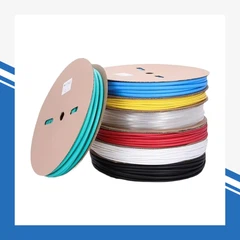


Heat Shrink Tube
Your Professional Heat Shrink Tube Supplier
Hangzhou Weshare Import & Export Co.,Ltd. is a leading Chinese manufacturer and exporter of transformer components, electrical insulation materials and consulting company. Weshare founded in 2005 by one specialized sales in transformer accessories. Most of our products are used in oil and dry transformers, electrical motors, generators and electronic products.Our mission is to ensure appropriate product quality while satisfying the needs of our customers is our prime objective and represents the core principle of our business activities.
-
![Insulation Protector Shrink Sleeve]()
-
![Insulation Shrink Tube]() Insulation Shrink TubeTensile strength(MPa):≥14read more
Insulation Shrink TubeTensile strength(MPa):≥14read more
Environmental certification: Passed EU RoHs certification -
![Insulation Heat Shrink Tube]()
-
![Heat Shrink Sleeve]()
-
![Heat Shrinkable Insulation Tube]() Heat Shrinkable Insulation TubeInner diameter (ID) range: 0.15-150mmread more
Heat Shrinkable Insulation TubeInner diameter (ID) range: 0.15-150mmread more
Shrinkage ratio: 2:1 to 6:1),Wall thickness error: ±0.08mm -
![High Temp Heat Shrink Sleeves]()
-
![Insulation Heat Shrink Tube for Cable]()
-
![Heat Shrink Tube for wire]()
-
![PE Heat Shrink Tubing]() PE Heat Shrink TubingPE heat shrink tubing is a tubular insulation material with a shape memory function, modified by electron beam irradiation based on cross-linked polyethylene (XLPE), which complies with UL 224....read more
PE Heat Shrink TubingPE heat shrink tubing is a tubular insulation material with a shape memory function, modified by electron beam irradiation based on cross-linked polyethylene (XLPE), which complies with UL 224....read more -
![Polyolefin Heat Shrink Tube Sleeve]() Polyolefin Heat Shrink Tube SleeveWhen heated (typical shrinkage temperature 120-135℃), it can shrink evenly to 1/3 of the original diameter (shrinkage ratio 3:1), with an operating temperature range of -55℃~135℃ and a withstand...read more
Polyolefin Heat Shrink Tube SleeveWhen heated (typical shrinkage temperature 120-135℃), it can shrink evenly to 1/3 of the original diameter (shrinkage ratio 3:1), with an operating temperature range of -55℃~135℃ and a withstand...read more -
![15mm Heat Shrink Tube]() 15mm Heat Shrink TubeThe heat shrinkable sleeve is made of high-quality polymer, which is scientifically proportioned and mechanically blended into a polymer alloy, and the product is cross-linked and continuously...read more
15mm Heat Shrink TubeThe heat shrinkable sleeve is made of high-quality polymer, which is scientifically proportioned and mechanically blended into a polymer alloy, and the product is cross-linked and continuously...read more -
![Wire Heat Shrink Tube]()


Why Choose Us
Quality Assurance
Certified by UL, SGS, and ISO9001, Weshare upholds stringent quality standards.
Extensive Experience
Weshare, since 2005, excels in transformer accessories and electrical engineering.
Export markets
With a strong focus on export markets, we have successfully captured significant market share in East Asia, North Europe, the Middle East, South America, Egypt, and East Africa. Our dedication to ensuring appropriate product quality while meeting customer needs is the cornerstone of our business philosophy.
Product Application
Our company boasts a wide array of products used in oil and dry transformers, electrical motors, generators, and electronic devices.
Advantages of Heat Shrink Tube
Protection
One of the prime benefits of heat shrink tubing is the protection offered to wires and cables when exposed to a variety of conditions and environments. In factories and manufacturing plants, wires and cables are subject to abrasion, scuffing, splitting, and constant wear when left exposed.
Insulation Properties
Insulation of electrical wires and cables is first and foremost required to prevent electrical shock. However, the insulation of wires and cables also prevents the loss and dissipation of energy being conducted through the wiring. The material properties of cable insulators are non-conductive and designed to provide a buffer with anyone or anything that may come in contact with the cabling.
Reduces Cable Stress
Though heat shrink tubing offers protection for cabling and wiring from exposure to environmental conditions, it also aids in preventing undue strain or stretching of wires and cables confined to insufficient space or length. Heat shrinking increases mechanical support for maintaining connectivity of wires and cables that otherwise would be subjected to strain and stress that could lead to premature failure.
Organization
There may be no better argument for the application of heat shrink tubing of wires, cabling, and components than to organize them. Bundling wires and cables are not only aesthetically pleasing, but good cable management allows for easy access during maintenance of the system.
Corrosion Resistance
Over time, in any environment, when oxygen combines with the metal it forms a new compound called oxide that weakens the bonds of the metal itself, causing it to corrode. Metals and their alloys used in wiring and cable applications can be made corrosion-resistant, but only insulating the material can ensure against corrosion.
Heat Shrink Tubing Materials

Polyolefin
Polyolefin is the most popular material for shrink tubing due to its thermal resistance. It is more expensive than PVC but capable of withstanding temperatures as high as 125-135°C. This property makes it ideal for manufacturing, industrial, and mechanical applications with high operating temperatures.

Adhesive-Lined Polyolefin
To provide a more secure tube that will not slip in critical conditions, manufacturers have created a polyolefin heat shrink tubing with an adhesive inner layer that melts and adheres to the wires and components inside the tube to fill voids and ensure a close fit. An added adhesive offers more support and increased protection from moisture and harsh conditions.

PVC
PVC is less expensive than polyolefin but has a lower temperature threshold of approximately 105°C. PVC is durable, strong, and highly abrasion-resistant. It can be manufactured with high clarity, bright colors, and flame-retardant qualities, making it a highly versatile and cost-effective option for low-temperature applications.
Types of Heat Shrink Tube
Polyolefin is the most common kind of heat shrink material, in part because its properties make it a great choice for most applications. It comes in a variety of colors. Shrink temperature is 120° C (229° F), and the material can perform continuously between temperatures of -55° C to +135° C (-67° F to +275° F).
Fabric heat shrink is a woven blend of materials, a combination of polyolefin and polyester. The woven structure makes it highly flexible while allowing it to retain strength and abrasion resistance. It has a low shrink temperature, 80° C (176° F), but a narrower range of operating temperatures, -40° C to +125° C (-40° F to +270° F). It also shrinks more longitudinally (lengthwise) than other heat shrinks.
Polyvinylchloride (PVC) is often used as a low-cost alternative to other heat-shrink materials. As an inert material, it’s good for food and drink applications. Its high UV resistance makes it a great choice for exposed applications. However, it does have some limitations, such as sensitivity to high temperatures. The shrink temperature for PVC is 100° C (212° F), and the range of operating temperatures is -55° C to 105° C (-67° F to +221° F). We do not ship this material without written authorization during the warmer months because of its heat sensitivity.
Polytetrafluoroethylene (PTFE AKA Teflon) is heat shrink tubing used when an application requires a high-temperature operation. PTFE tubing can operate safely at temperatures ranging from -67° C to +250° C (-88° F to +482° F). The shrink temperature of 340° C (644° F) also makes it hard for most people to use this material in standard applications.
Paramenters
|
Property |
Test method |
Standard |
Typical Performance |
|
Tensile strength(MPa) |
ASTM D2671 |
≥10.4 |
12.68 |
|
Elongation(%) |
ASTM D2671 |
≥200 |
448.72 |
|
Tensile strength after aging(MPa) |
UL224 158℃X168hr |
≥7.3 |
11.45 |
|
Elongation after aging (%) |
UL224 158℃X168hr |
≥100 |
390.41 |
|
Flammability |
ASTM D2671B |
Pass |
Pass |
|
Dielectric strength(kV/mm) |
IEC 60243 |
≥15 |
18.25 |
|
Volume resistivity(Ω.cm) |
IEC 60093 |
≥1X10¹⁴ |
1.86X10¹⁴ |

Material Selection: The process begins with choosing base polymers like polyethylene (PE), polyvinylidene fluoride (PVDF), or elastomers. Additives (e.g., stabilizers, colorants) are blended to enhance properties like UV resistance or flame retardancy.
Extrusion: The polymer mix is melted and extruded through a circular die to form a tube. Precise temperature control ensures uniform thickness and smooth surfaces. The extruded tube is cooled in water baths to solidify its initial shape.
Cross-Linking: To enable heat-shrink capabilities, the tubing undergoes cross-linking via electron beam irradiation or chemical methods. This creates molecular bonds, improving thermal stability and mechanical strength.
Expansion: The tube is reheated to a rubbery state and mechanically or pneumatically stretched to a larger diameter. It is then rapidly cooled (quenched) to “lock” the expanded shape.
Finishing: The tubing is cut to specified lengths, inspected for defects (e.g., dimensional accuracy, shrinkage ratio), and tested for electrical/mechanical performance. Surface printing or labeling may be added.
Packaging: Finished tubes are coiled or packed for shipment, often with anti-static or moisture-resistant measures.
Application of Heat Shrink Tube
Electrical Insulation
Covers exposed wires and connectors, preventing short circuits and enhancing safety by providing a non-conductive barrier.
01
Strain Relief
Reduces mechanical stress on electrical connections, protecting them from bending or pulling forces that could lead to failure.
02
Environmental Protection
Shields from external elements such as moisture, chemicals, and UV exposure, making it ideal for outdoor and harsh environments.
03
Wire Bundling
Organizes multiple wires into a single, manageable group, reducing clutter and improving overall cable management.
04
Identification
Utilized for labeling and color-coding wires, which simplifies circuit management and troubleshooting tasks.
05
FAQ
As one of the leading heat shrink tube suppliers in China, we warmly welcome you to wholesale high-grade heat shrink tube made in China here from our factory. All our products are with high quality and competitive price.