







Product Description
Heat Shrink Breakout
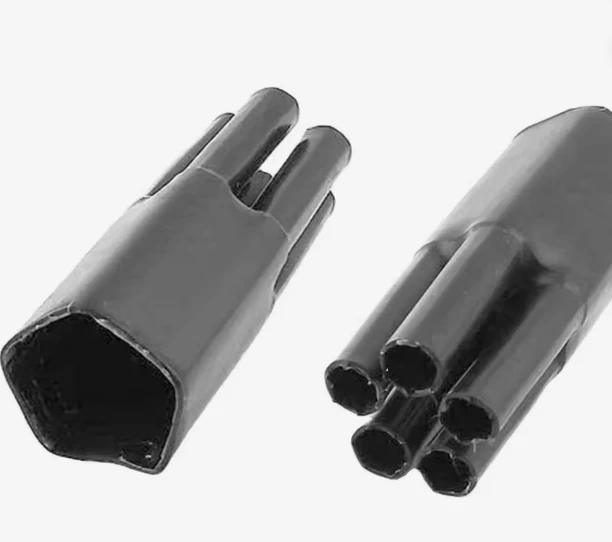
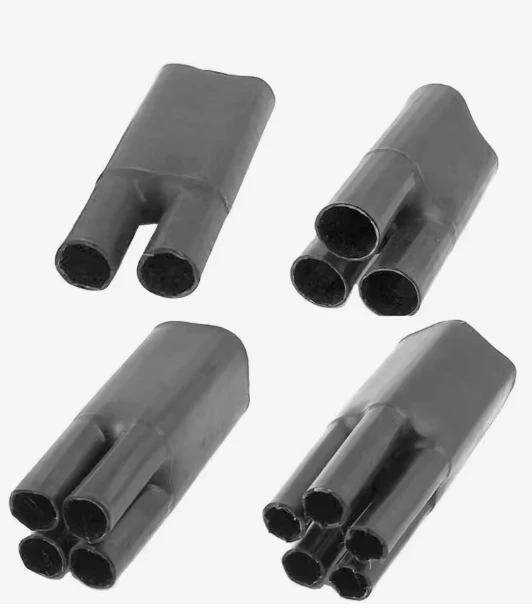
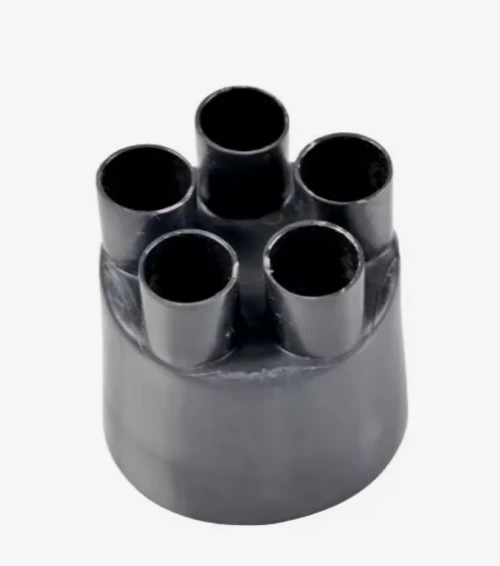
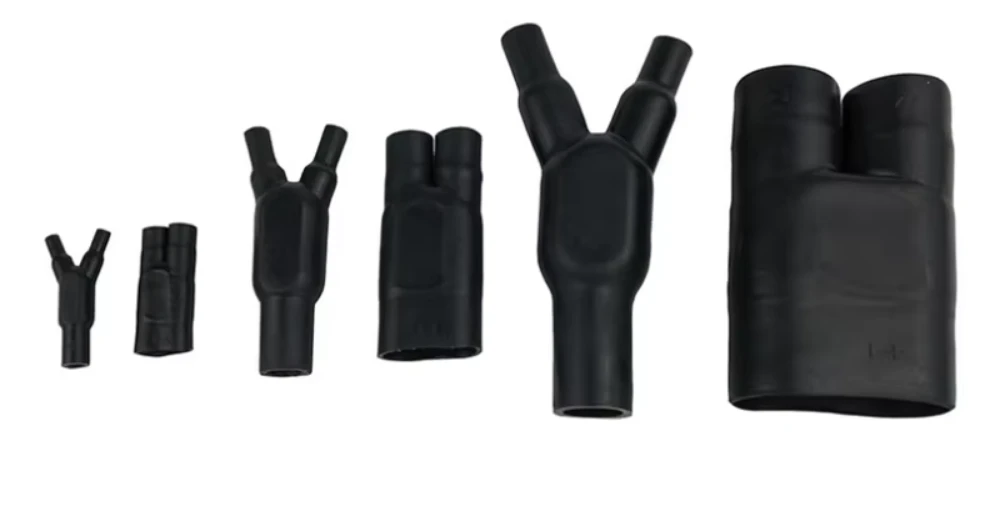
The heat shrink breakout is a moulded, multi-legged cross-linked polyolefin boot that seals and provides strain relief at the "crutch" of a multi-core cable - the point where the outer sheath ends and the individual cores separate. Standard configurations cover 2-, 3-, 4- and 5-core cable, so whether you are breaking out a small control cable or a large armoured multicore, there is a boot to match.
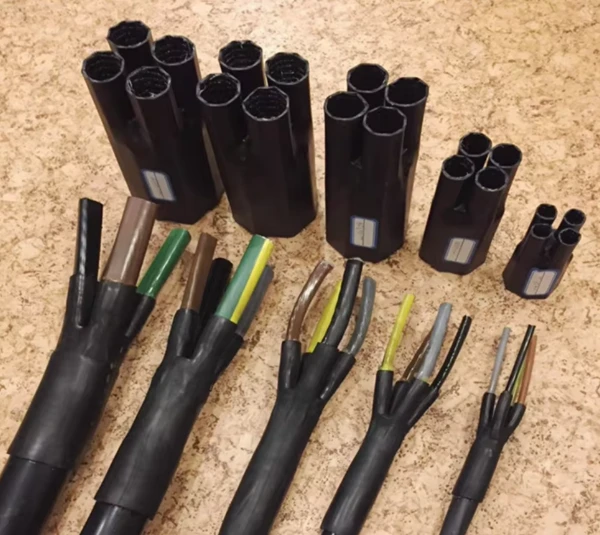
It is coated with hot-melt adhesive on both the body and the fingers, so during recovery the boot bonds to the cable sheath and to each individual core, forming a watertight seal across the whole branch. The moulded legs hold the cores in their correct fan-out angle and take the mechanical load off the crutch, preventing the sheath from splitting or the cores from chafing where they bend apart.
Available in three material variants - insulated, oil-resistant and semi-conductive - and with an optional flame-retardant compound, the breakout meets a wide range of configuration requirements. Shrinking begins at 90 °C and the boot is fully recovered at 130 °C.
At a glance
Form: moulded branching boot (2-, 3-, 4- and 5-core) - not a straight tube
Material: cross-linked polyolefin, adhesive-coated on body and fingers
Function: watertight seal + strain relief at the cable crutch
Variants: insulated / oil-resistant / semi-conductive; flame-retardant on request
Adhesive forms: flat adhesive and spiral adhesive
Shrink temperature: starts at 90 °C, fully recovered at 130 °C
Sizes: 28 standard specs across the four core counts
Why a breakout boot is a different product from a tube
A straight heat-shrink tube can only cover a single cylindrical run. The moment a multi-core cable splits into separate cores, a tube cannot follow the change in geometry - and that split is exactly where water wicks in and where mechanical strain concentrates.
The cable breakout boot solves this because it is moulded into a branch shape: a single body grips the cable sheath and then fans into 2, 3, 4 or 5 fingers, one for each core. Because the adhesive runs along the body and down every finger, the recovered boot seals each core entry point individually - something no straight sleeve can do.
The result, at the crutch of the cable:
Water cannot track from the sheath along the cores, because each finger is sealed.
The cores cannot chafe or split the sheath, because the moulded legs fix the fan-out angle and carry the strain.
The branch stays insulated (insulated / oil-resistant variants) or is stress-graded / screened (semi-conductive variant) according to the application.
Applications
Multi-core cable crutch / breakout - sealing and strain relief where the sheath splits into cores
LV power and control cables - 2-, 3-, 4- and 5-core, sheathed and armoured
Oil-contaminated environments - oil-resistant variant for machinery, pumps and plant rooms
Screened / stress-graded joints - semi-conductive variant where the breakout must continue the screen
Harness and loom manufacturing - branch sealing on multi-core assemblies
Marine, outdoor and buried cable runs - watertight branch protection
Panel and switchgear wiring - tidy, sealed core breakouts at cable entries
Key features & benefits
True branching geometry - moulded 2-, 3-, 4- and 5-core boots; the only product in the range that covers a cable crutch.
Watertight at every core - hot-melt adhesive on the body and all fingers seals each core entry, not just the cable entry.
Strain relief at the crutch - the moulded legs hold the fan-out angle and remove mechanical load from the sheath split.
Three material variants - insulated, oil-resistant and semi-conductive, to match LV insulation, oily environments, or screened / stress-graded service.
Optional flame retardant - flame-retardant breakouts available upon customer request.
Two adhesive forms - flat adhesive and spiral adhesive, to suit different cable and tooling requirements.
Tough, stable compound - tensile strength ≥ 12 MPa, elongation at break ≥ 300 %; ≥ 10 MPa and ≥ 230 % retained after 120 °C × 168 h ageing.
Reliable dielectric data (insulated / oil-resistant) - dielectric strength ≥ 15 kV/mm; water absorption ≤ 0.1 %.
Wide thermal range - brittle temperature −40 °C; heat shock 160 °C / 4 h, no cracking.
Controlled recovery - begins at 90 °C, fully recovered at 130 °C.
How the breakout differs from the straight-tube siblings
| Product | Form | Function | Core count | Adhesive | Where it goes |
|---|---|---|---|---|---|
| WRSZT - Heat Shrink Breakout (this page) | Moulded branching boot | Seal + strain relief at the cable crutch | 2 / 3 / 4 / 5 | Body + fingers (flat or spiral) | The branch where the sheath splits into cores |
| WRSHG - Heat Shrink Protective Tube | Straight tube | Insulate, seal, armour | 1 (single run) | Both ends | Over a joint, termination, busbar or pipe |
| WRSJG - Anti-Tracking Insulation Tube | Straight tube | Anti-tracking / anti-flashover | 1 | One end | MV terminations & busbars |
| WDWT - Semi-conductive Dual Layer Tube | Straight tube | Insulation + screen rebuild | 1 | Adhesive-free | MV cable joint body |
| WRSYL - Stress Control Tube | Straight tube | Field grading | 1 | None | Screen cut-back of MV terminations & joints |
In short: the four tubes are straight sleeves for a single cylindrical run. The breakout is the only branch-shaped part - choose it specifically for the crutch of a multi-core cable, where a tube physically cannot follow the geometry and where each core must be sealed individually.
Technical specifications
Selection table - standard sizes
All dimensions in mm. D = body diameter, d = finger diameter, L = full length (± 5).
2-core breakout
| Spec. | As supplied D min | As supplied d min | Full length L | Recovered D max | Recovered d max |
|---|---|---|---|---|---|
| WRSZT2-24/14 (0#) | 24 | 12 | 140 | 14 | 5 |
| WRSZT2-38/18 (1#) | 38 | 20 | 145 | 18 | 7 |
| WRSZT2-45/22 (2#) | 45 | 25 | 145 | 22 | 10 |
| WRSZT2-60/25 (3#) | 60 | 35 | 140 | 25 | 11 |
| WRSZT2-70/25 (4#) | 70 | 40 | 140 | 25 | 11 |
3-core breakout
| Spec. | As supplied D min | As supplied d min | Full length L | Recovered D max | Recovered d max |
|---|---|---|---|---|---|
| WRSZT3-24/17 (2#) | 24 | 11 | 140 | 17 | 5 |
| WRSZT3-48/22 (1#) | 48 | 18 | 165 | 22 | 7 |
| WRSZT3-58/28 (0#) | 58 | 25 | 180 | 28 | 8 |
| WRSZT3-68/37 (1#) ★ | 68 | 30 | 210 | 37 | 13 |
| WRSZT3-87/43 (2#) ★ | 87 | 39 | 220 | 43 | 16 |
| WRSZT3-106/53 (3#) ★ | 106 | 42 | 235 | 53 | 19 |
| WRSZT3-125/65 (4#) ★ | 125 | 58 | 245 | 65 | 25 |
| WRSZT3-140/65 (5#) ★ | 140 | 65 | 245 | 65 | 25 |
4-core breakout
| Spec. | As supplied D min | As supplied d min | Full length L | Recovered D max | Recovered d max |
|---|---|---|---|---|---|
| WRSZT4-38/19 (0#) | 38 | 10 | 125 | 19 | 5 |
| WRSZT4-50/25 (1#) ★ | 50 | 16 | 135 | 25 | 7 |
| WRSZT4-70/32 (2#) ★ | 70 | 23 | 185 | 32 | 10 |
| WRSZT4-82/46 (3#) ★ | 82 | 30 | 210 | 46 | 13 |
| WRSZT4-90/46 (4#) ★ | 90 | 35 | 210 | 46 | 13 |
| WRSZT4-109/54 (5#) | 109 | 42 | 240 | 54 | 18 |
5-core breakout
| Spec. | As supplied D min | As supplied d min | Full length L | Recovered D max | Recovered d max |
|---|---|---|---|---|---|
| WRSZT5-42/21 (0#) | 42 | 11 | 130 | 21 | 5 |
| WRSZT5-57/30 (1#) | 57 | 15 | 170 | 30 | 7 |
| WRSZT5-70/38 (2#) | 70 | 23 | 170 | 38 | 9 |
| WRSZT5-90/53 (3#) | 90 | 30 | 180 | 53 | 13 |
| WRSZT5-120/48 (4#) | 120 | 39 | 205 | 48 | 14 |
Remarks
★ - 3-core semi-conductive breakouts are available upon custom request.
☆ - 3-core or 4-core oil-resistant breakouts are available upon custom request.
The breakout is coated with hot-melt adhesive in two forms - flat adhesive and spiral adhesive - to meet different customer needs.
Technical data
| Property | Test method | Insulated breakout | Oil-resistant breakout | Semi-conductive breakout |
|---|---|---|---|---|
| Tensile strength | ASTM D-638 | ≥ 12 MPa | ≥ 12 MPa | ≥ 12 MPa |
| Elongation at break (120 °C, 168 h) | ASTM D-638 | ≥ 300 % | ≥ 300 % | ≥ 300 % |
| Tensile strength after ageing (120 °C, 168 h) | ASTM D-638 | ≥ 10 MPa | ≥ 10 MPa | ≥ 10 MPa |
| Elongation at break after ageing | ASTM D-638 | ≥ 230 % | ≥ 230 % | ≥ 230 % |
| Tensile strength variation after dipping | ASTM D-638 | - | ≤ 20 % | - |
| Elongation at break after dipping | ASTM D-638 | - | ≥ 230 % | - |
| Dielectric strength | IEC 60243 | ≥ 15 kV/mm | ≥ 15 kV/mm | - |
| Water absorption | ISO 62 | ≤ 0.1 % | ≤ 0.1 % | ≤ 0.1 % |
| Volume resistivity | IEC 60093 | ≥ 1×10¹⁴ Ω·cm | ≥ 1×10¹⁴ Ω·cm | ≤ 1×10¹⁰ Ω·cm |
| Brittle temperature | ISO 974 | −40 °C | −40 °C | −40 °C |
| Heat shock | 160 °C, 4 h | No crack | No crack | No crack |
| Hardness (Shore A) | ISO 868 | ≥ 80 | ≥ 80 | ≥ 80 |
How to select the right breakout
Count the cores - choose the 2-, 3-, 4- or 5-core boot to match the cable construction (e.g. a 4-core cable → WRSZT4 series).
Measure the cable sheath OD - this must fit inside the as-supplied body diameter (D min). Example: a 46 mm-sheath cable → WRSZT4-109/54 (D min 109 mm slides over).
Measure each core OD - all cores must fit through the as-supplied finger diameter (d min) and be gripped by the recovered finger diameter (d max).
Check the full length (L) - confirm the boot covers from the intact sheath, across the crutch, and down each core far enough for a proper seal. Standard L runs 125–245 mm.
Choose the material variant - insulated for normal LV service; oil-resistant where oil or fuel is present; semi-conductive where the breakout must continue a screen / grade stress.
Choose the adhesive form - flat or spiral hot-melt, depending on the cable and your tooling.
Product display
Certificate

FAQ
Q: What is a heat shrink breakout used for? A: It seals and provides strain relief at the crutch of a multi-core cable - the point where the outer sheath splits into the individual cores. It is available for 2-, 3-, 4- and 5-core cable.
Q: How is this different from a heat shrink tube? A: A tube is a straight, single-leg sleeve for one cylindrical run. The breakout is a moulded branching boot with 2–5 fingers - the only product in the range that follows the geometry of a cable crutch and seals each core individually.
Q: Where is the adhesive? A: The boot is coated with hot-melt adhesive on the body and on the fingers, so it forms a watertight seal at the sheath entry and at every core exit. It is supplied with either flat or spiral adhesive.
Q: What material variants are available? A: Insulated, oil-resistant and semi-conductive. The oil-resistant variant is the one tested for dipping (≤ 20 % tensile variation, ≥ 230 % elongation after dipping). Flame-retardant breakouts are available on request.
Q: Which core counts are standard? A: 2-, 3-, 4- and 5-core, across 28 standard specs, with 3-core semi-conductive and 3-/4-core oil-resistant types available on custom request.
Q: What is the shrink temperature? A: Shrinking starts at 90 °C and the boot is fully recovered at 130 °C.
Q: How do I size it? A: Choose by core count, then match the cable sheath OD to the as-supplied body diameter (D min) and each core OD to the finger diameter range (d min → d max recovered).
Hot Tags: heat shrink breakout, China heat shrink breakout suppliers