

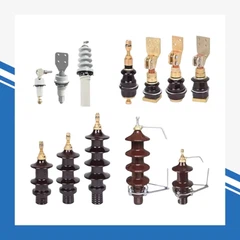






Composite Insulator
Your Professional Composite Insulator Supplier
Hangzhou Weshare Import & Export Co.,Ltd. is a leading Chinese manufacturer and exporter of transformer components, electrical insulation materials and consulting company. Weshare founded in 2005 by one specialized sales in transformer accessories. Most of our products are used in oil and dry transformers, electrical motors, generators and electronic products.Our mission is to ensure appropriate product quality while satisfying the needs of our customers is our prime objective and represents the core principle of our business activities.
-
![LV Busbar Support Post Insulator]() LV Busbar Support Post InsulatorGlass-fibre reinforced BMC post insulator for LV busbar support. 40 mm and 100 mm heights, M10/M12 female threads, 1000 V AC / 1500 V DC, UL 94 V-0, CTI >= 600 V.read more
-
![Post Composite Insulator]() Post Composite InsulatorHorizontal Line Post Insulator is an insulating device used in substations and power transmission lines, mainly used to support and fix conductors and provide electrical insulation.read more


Why Choose Us
Quality Assurance
Certified by UL, SGS, and ISO9001, Weshare upholds stringent quality standards.
Extensive Experience
Weshare, since 2005, excels in transformer accessories and electrical engineering.
Export markets
With a strong focus on export markets, we have successfully captured significant market share in East Asia, North Europe, the Middle East, South America, Egypt, and East Africa. Our dedication to ensuring appropriate product quality while meeting customer needs is the cornerstone of our business philosophy.
Product Application
Our company boasts a wide array of products used in oil and dry transformers, electrical motors, generators, and electronic devices.
Advantages of Composite Insulator
Lightweight: Compared to porcelain insulator or glass-type insulator, composite ones are much lighter. This makes it very convenient when it comes to transportation, installation, and tying of bolts.
High Mechanical Strength: As light as these insulators are, they are still astonishingly strong. The fibreglass core provides exceptional strength, enabling resistance to heavy loads, bast winds, and tension power lines without breaking.
Excellent Weather Resistance: These rugged devices remain functional in any weather condition. The silicone rubber guards against rain, UV sunlight, snow, and severe temperatures. In addition, these insulators work great in dusty, salty, or polluted places.
Superior Electrical Performance: The prevention of current leakage and reduction of flashovers, which stabilise and secure the power supply, are facilitated by the clean and dry surface of the rubber housing and sheds.
Low Maintenance: Because these insulators aren’t exposed to dust and/or water, composite insulators require less care. The amount of routine checkups and cleaning will eventually save time and money in the long run.
Longer Service Life: Due to the robust materials and solid construction, composite insulators can last for several years. Yes, they resist cracking, ageing, and environmental damage, making them an enduring asset to power systems.
Better Safety: Compared to other types of insulators, these are considerably safer. Unlike glass, these do not shatter into sharp shards. Their advanced design helps mitigate many accidents and damage to the equipment during regular operation and maintenance.
Types of Composite Insulator
Composite Line Post Insulators: Often called High Voltage Composite Insulators, these are used on upright posts in high-voltage power lines. They handle extreme electrical stress while keeping power lines securely attached to structures like steel towers.
Composite Pin-Type Insulators: Also known as Composite Pin Insulators, these are mostly used in power transmission lines and substations, especially for high or ultra-high voltage systems. They’re designed to hold single power lines at suspension points, keeping electricity isolated from support structures like poles or towers.
Cross-Arm Insulators: These insulators are mounted on the horizontal cross-arms of power towers. Their job is to support power lines while blocking electricity from leaking between the cables and the tower. By safely holding the cables, they keep the grid stable and reduce the risk of outages.
Composite Post Insulators: Sometimes called Line Post Insulators, these are installed on vertical posts in high-voltage transmission systems. They’re popular for their strong electrical insulation, durability in tough weather, and lightweight design, which makes them easier to transport and install.
Composite Insulator Structure and Materials

Core Rod
The core is the insulator's centre part. It is usually made of Fibreglass reinforced plastic (FRP). Well, this is the rod that makes the insulator strong. It bears the mechanical stress from the power line and resists shear, tensile, and compressive failure. Moreover, the fibreglass core is extremely light but verifiably strong.

Housing and Sheds
The outer part of the insulator is called the housing. It is normally composed of silicone rubber and sometimes EPDM rubber. The housing is molded into small “sheds”. These sheds help increase the surface distance over which electricity would need to travel, preventing leakage and flashovers.

Metal End Fittings
The insulator is provided with metal end fittings. These are made of galvanised steel or aluminium. The fittings are used to attach the insulator to power lines, poles, or other accessories. The bond between the core and these metal ends is very strong.
Composite Insulator Applications
High Voltage Transmission Lines
They are used nowadays to hold power lines which pass electricity over extremely long distances. They ensure that the wires remain safely apart and can withstand severe outside conditions.
The Medium Voltage Distribution Networks
With respect to urban areas, composite insulators are the best suited for power distribution. Well, it is because of their ease of installation and reduction of maintenance costs.
Electrical Substations
Composite insulators aid in the support of busbars and transformers in substations. Their good insulation protects against burn faults, sags, and trips that occur in power systems.
Railway Electrification Systems
Composite insulators are used for the support of overhead wires in electric railways. These insulators are capable of withstanding vibrations, weather changes, and heavy mechanical stress.
Switchgear and Control Equipment
In modern electrical systems, composite insulators are used within control and switchgear panels. They provide safe insulation in confined areas. Moreover, their compact size allows easy fitting.
Coastal and Polluted Areas
Compared to conventional insulators, composite ones withstand salt, pollution, and moisture better. It makes them ideal for use in maritime power lines and industrial zones.
FAQ
As one of the leading composite insulator suppliers in China, we warmly welcome you to wholesale high-grade composite insulator made in China here from our factory. All our products are with high quality and competitive price.