

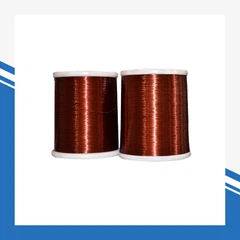







Micro enameled wire (0.04-0.10mm) product performance advantages:
High elongation:0.05mm elongation 28%~30%, meeting the processing requirements of ultra-high-speed winding machines.

Magnet Wire
Your Professional Magnet Wire Supplier
Hangzhou Weshare Import & Export Co.,Ltd. is a leading Chinese manufacturer and exporter of transformer components, electrical insulation materials and consulting company. Weshare founded in 2005 by one specialized sales in transformer accessories. Most of our products are used in oil and dry transformers, electrical motors, generators and electronic products.Our mission is to ensure appropriate product quality while satisfying the needs of our customers is our prime objective and represents the core principle of our business activities.
-
![Enameled Copper Magnet Wire]()
-
![Polyesterimide Enamelled Copper Wire]() Polyesterimide Enamelled Copper WireEIW/180 enamelled copper wire, 0.08–3.50 mm. Built for winding tension, abrasion, cut-through and thermal shock. GB/T 6109.5, IEC 60317-8.read more
-
![Polyester Enamelled Round Copper Wire]() Polyester Enamelled Round Copper WireMost motor and appliance manufacturers do not buy to one standard. They buy to four, because their customers' drawings do: a domestic project cites GB/T, a European one cites IEC, a Japanese...read more
-
![Enamelled Aluminium Round Wire Class 240]() Enamelled Aluminium Round Wire Class 240Where voice coil winding scrap actually comes from, how thermal class affects BOM cost, and how to pick the lowest class that survives your duty.read more
-
![Polyester Overcoated With Polyamide-Imide Enamelled Aluminium Wire]() Polyester Overcoated With Polyamide-Imide Enamelled Alumi...Class 220 enamelled aluminium wire, EI/AIW/220 Q(ZY/XY)/L, 0.20–6.00 mm. For high-power-density transformers, inverter reactors and sealed high-ambient designs.read more
-
![Polyester(imide) Overcoated With Polyamide-Imide Enamelled Aluminium Wire]() Polyester(imide) Overcoated With Polyamide-Imide Enamelle...Class 200 enamelled aluminium wire with polyester(imide) base and polyamide-imide overcoat. For cast-resin transformers, hermetic compressors, inverter magnetics.read more
-
![Polyesterimide Enamelled Aluminium Round Wire, Class 180]() Polyesterimide Enamelled Aluminium Round Wire, Class 180Class 180 enamelled aluminium round wire, EIW/180 QZY/L, 0.20–6.00 mm to IEC 60317-15 and NEMA MW 76-A. TDS and free samples on request.read more
-
![Polyester Enamelled Aluminium Round Wire]() Polyester Enamelled Aluminium Round WirePEWA130 and PEWA155 enamelled aluminium round wire, 0.20–6.00 mm to GB/T 23312.3 and NEMA MW 24-A, for appliance motors and distribution transformers.read more
-
![Transposed Conductors]()
-
![Oxygen-free Copper Flat Wire]()
-
![Aramid Paper Covered Wire]() Aramid Paper Covered WireProducts Description Aramid paper-covered wire is a specialty winding conductor with a copper core uniformly covered with aramid insulating paper. It is primarily used in high-temperature,...read more
-
![Copper Wire Enamel Coating]()


Why Choose Us
Quality Assurance
Certified by UL, SGS, and ISO9001, Weshare upholds stringent quality standards.
Extensive Experience
Weshare, since 2005, excels in transformer accessories and electrical engineering.
Export markets
With a strong focus on export markets, we have successfully captured significant market share in East Asia, North Europe, the Middle East, South America, Egypt, and East Africa. Our dedication to ensuring appropriate product quality while meeting customer needs is the cornerstone of our business philosophy.
Product Application
Our company boasts a wide array of products used in oil and dry transformers, electrical motors, generators, and electronic devices.
Advantages of Magnet Wire
Excellent Electrical Conductivity: Copper is highly conductive, making it an ideal material for transmitting electricity efficiently.
Insulation: The enamel coating provides insulation, preventing short circuits and ensuring the safe operation of electrical devices.
High Temperature Resistance: Enameled copper wire can withstand high temperatures without compromising its electrical properties, making it suitable for a wide range of applications.
Thin Insulation Layer: The enamel coating is typically very thin, allowing for compact winding in coils and transformers.
Durability: Enameled copper wire is resistant to abrasion and mechanical damage, ensuring long-term reliability in various operating conditions.
Flexibility: Despite its insulation, enameled copper wire remains flexible, facilitating easy installation and handling in tight spaces.
Corrosion Resistance: Copper is inherently resistant to corrosion, ensuring the longevity of enameled copper wire even in harsh environments.
Cost-Effectiveness: Copper is readily available and relatively inexpensive compared to other conductive materials, making enameled copper wire a cost-effective choice for many applications.
Wide Range of Sizes: Enameled copper wire is available in various sizes and gauges to suit different voltage and current requirements.
Compatibility: Enameled copper wire is compatible with standard soldering techniques, allowing for easy connections in electronic circuits and devices.
Specification
|
Property |
Value |
|
Elongation |
>30% |
|
Springiness |
<45 |
|
Adherence - Flexibility |
Excellent |
|
Resistance to Abrasion |
>17.75N |
|
Breakdown Voltage |
7kV |
|
Temperature Index |
200 |
|
Cut through |
≥ 225 °C |
|
Heat Shock |
≥320 °C |
|
Solvent Test |
4H |
|
Resistance to Refrigerants |
- |
Production process of Magnet Wire
The general enameled wire production process is as follows: pay-off → annealing → painting → baking → cooling → lubrication → take-up.


Pay off Line
The key to paying off the line is to control the tension. When the tension is high, it not only thins the conductor and makes the surface of the wire lose its brightness, but also affects many properties of the enameled wire. From the appearance, the enameled wire produced by the thinned wire has a poor luster.
Annealing
The purpose of annealing is to heat the conductor, which has become hardened due to lattice changes during the mold stretching process, to a certain temperature so that the molecular lattice can be rearranged and the softness required by the process can be restored. At the same time, the lubricant, oil stains, etc. remaining on the surface of the conductor during the stretching process are removed, making the conductor easy to paint and ensuring the quality of the enameled wire.
Paint
Painting is the process of applying enameled wire paint on metal conductors to form a uniform paint layer with a certain thickness. Generally, enameled wire paint must be coated and baked multiple times to fully evaporate the solvent and completely react with the paint-based resin to form a good paint film.
Baking
After the wire is painted, it enters the oven. The solvent in the paint solution is first evaporated and then solidified to form a paint film. Then paint and bake, repeating this several times to complete the entire baking process of the enameled bag.
Lubricating
The lubrication of the enameled wire has a great relationship with the tightness of the wire take-up. The lubricant used for enameled wire must be able to make the surface of the enameled wire slippery, be non-harmful to the wire, and must not affect the strength of the take-up reel and the user’s use.
Take up line
The purpose of winding and arranging the wire is to wind the enameled wire onto the spool continuously, tightly and evenly. The take-up mechanism is required to have smooth transmission, low noise, appropriate tension and regular cable arrangement. Among the quality problems of enameled wire, a large proportion of returns are caused by poor take-up and arrangement.
Applications of Magnet Wire in Modern Technology
Electric Motors
Electric motors are ubiquitous in modern life, powering everything from household appliances to industrial machinery. Magnetic wire is a key component in the construction of electric motors, used in the windings of the stator and rotor. The wire’s ability to carry electrical current with minimal loss and its excellent insulation properties make it ideal for this application.
Transformers
Transformers are essential for the transmission and distribution of electrical power. They rely on magnetic wire for their windings, which create the magnetic field necessary for transforming voltage levels. Both power and distribution transformers use large quantities of magnet wire to handle high currents and voltages.
Inductors
Inductors, used in various electronic circuits, depend on magnet wire to create the inductive properties required for their operation. These components are found in power supplies, filters, and many other electronic devices. The wire is wound into coils to create the magnetic field that characterizes inductors.
Relays and Solenoids
Relays and solenoids use magnet wire to create electromagnetic fields that control switches and mechanical movements. These components are critical in automation systems, automotive applications, and many types of machinery.
Generators
Generators convert mechanical energy into electrical energy and are essential in power plants, emergency backup systems, and renewable energy applications. Magnet wire is used in the windings of the generator’s stator and rotor, enabling the generation of electricity.
Electromagnets
Electromagnets, which are used in various applications including magnetic levitation, MRI machines, and industrial lifting, rely on magnetic wire to create magnetic fields. The wire is wound into coils and energized to produce the required magnetic force.
Headphones and Loudspeakers
In audio devices like headphones and loudspeakers, magnet wire is used in the voice coils that drive the speaker diaphragms. The wire creates an electromagnetic field that interacts with a permanent magnet to produce sound.
Hard Disk Drives (HDDs)
Hard disk drives use magnet wire in the voice coil actuators that position the read/write heads over the disk platters. This precise movement is essential for reading and writing data accurately.
FAQ
As one of the leading magnet wire suppliers in China, we warmly welcome you to wholesale high-grade magnet wire made in China here from our factory. All our products are with high quality and competitive price.
transformer winding assembly, winding temperature of transformer, aerospace service application of transformer winding