






Anti-fouling Insulator
Your Professional Anti-Fouling Insulator Supplier
Hangzhou Weshare Import & Export Co.,Ltd. is a leading Chinese manufacturer and exporter of transformer components, electrical insulation materials and consulting company. Weshare founded in 2005 by one specialized sales in transformer accessories. Most of our products are used in oil and dry transformers, electrical motors, generators and electronic products.Our mission is to ensure appropriate product quality while satisfying the needs of our customers is our prime objective and represents the core principle of our business activities.
-
![Anti-fouling Hanging Porcelain Insulator]() Anti-fouling Hanging Porcelain InsulatorProducts Description Anti-pollution type suspension insulators are specially designed high-voltage porcelain or glass insulators used in heavily polluted, coastal, industrial, desert, and...read more
Anti-fouling Hanging Porcelain InsulatorProducts Description Anti-pollution type suspension insulators are specially designed high-voltage porcelain or glass insulators used in heavily polluted, coastal, industrial, desert, and...read more -
![Anti Pollution Type Suspension Insulators]() Anti Pollution Type Suspension InsulatorsProducts Description Anti-pollution type suspension insulators are specially designed high-voltage porcelain or glass insulators used in heavily polluted, coastal, industrial, desert, and...read more
Anti Pollution Type Suspension InsulatorsProducts Description Anti-pollution type suspension insulators are specially designed high-voltage porcelain or glass insulators used in heavily polluted, coastal, industrial, desert, and...read more -
![Flashover Coating Insulator]()
-
![RTV Coated Porcelain Insulator]()
-
![RTV Silicone Coating insulator]()
-
![Anti-pollution Flashover Insulator]()
-
![Enhanced Anti-pollution Flashover insulator]()
-
![Insulator Anti-pollution Flashover Coating RTV]()


Why Choose Us
Quality Assurance
Certified by UL, SGS, and ISO9001, Weshare upholds stringent quality standards.
Extensive Experience
Weshare, since 2005, excels in transformer accessories and electrical engineering.
Export markets
With a strong focus on export markets, we have successfully captured significant market share in East Asia, North Europe, the Middle East, South America, Egypt, and East Africa. Our dedication to ensuring appropriate product quality while meeting customer needs is the cornerstone of our business philosophy.
Product Application
Our company boasts a wide array of products used in oil and dry transformers, electrical motors, generators, and electronic devices.
Characteristics of Anti-Fouling Insulator

Prevent environmental pollution
The surface of the dirt-resistant porcelain insulator is specially treated to prevent dust, dirt and other pollutants from being deposited on its surface, thus maintaining the insulating properties of the insulator.

Improve the reliability of equipment
The use of dirt-resistant porcelain insulators can improve the reliability and safety of power equipment, to ensure the stable operation of the power system.

Reduce the failure rate
As the dirt-resistant porcelain insulators have good dirt-resistant performance, it can reduce the insulator flashover and breakdown accidents caused by pollution, and reduce the failure rate of power equipment.

Reduce Maintenance Costs
Traditional insulators need to be cleaned and replaced regularly, while the pollution-resistant porcelain insulators can reduce the frequency of cleaning and replacement and reduce maintenance costs due to the strong anti-fouling performance of the surface and the fact that pollutants are not easy to be deposited.
Product Paramenters
|
Project |
5627 technical requirements |
Testing method |
|
|
Visual inspection |
No impurities, no floc precipitation, smooth and bubble-free after curing |
GB 1721 |
|
|
Solid content% |
≮50 |
GB 1725 |
|
|
Viscosity |
≮80 |
GB 1723 |
|
|
Vulcanization time |
Surface stem ≯45 min |
GB 6753.2 |
|
|
Hard work≯72h |
|||
|
Volume resistivityΩ·m |
≮1*10^12 |
GB 1410 |
|
|
Relative permittivity Loss tangent |
≯4.0 |
GB 1409 |
|
|
>0.4% |
|||
|
Dyeability test grade |
FV-1 |
GB/T10707 |
|
|
Dielectric strength kV/mm |
≮18 |
GB 1408 |
|
|
Tear strength test kN/m |
≮3 |
GB/T529 |
|
|
Mechanical tear strength MPa Tensile elongation% |
≥1.2 |
GB/T528 |
|
|
≥150 |
|||
|
Resistant to leakage and tracking and electrically corrosive TMA |
≥2.5 |
GB 6553 |
|
|
Adhesion |
Circle level |
Not less than level 2 |
GB 1720 |
|
Shear strength MPa |
≮0.8 |
GB/T13936 |
|
|
Wear resistance g |
≯0.3 |
GB 1768 |
|
|
Hydrophobicity test |
Monk water properties and classification |
Qa≥100° Qmin≥90° HC1 〜2 |
DL/T864 |
|
Loss of characteristics 96h |
Qav≥90° Qmin≥85° HC3〜4 |
||
|
Recovery properties |
Tx≤24h |
||
|
Monk water migration characteristics 96h |
Qav≥100° Qmin≥100° HC1〜3 |
||
|
Resistant to corrosion (acids, alkalis, salts and transformer oils) |
No wrinkling, peeling, blistering, discoloration, etc. |
GB 1739 GB 1763 |
|
|
Dirt resistant |
U1 (coated>/U2 (uncoated)>1.5 |
GB 4585 |
|
Types of anti-fouling insulators
Coatings
These include paints that release biocides (e.g., copper-based) or create a low-surface-energy surface that makes it difficult for organisms to attach (e.g., silicone-based, according to MDPI).
Physical methods
Ultrasonic systems, for instance, utilize high-frequency sound waves to create an environment that deters marine growth.
Other technologies
These may include films or sheathing with properties that prevent attachment or methods like copper-nickel composites.
Production process of Anti-Fouling Insulator
Raw material preparation: For porcelain insulators, this involves mixing and finely grinding raw materials like kaolin, quartz, and feldspar to create a clay-like consistency.
Forming: The insulator material is then shaped, typically through pressing or extrusion followed by machining on a lathe, to achieve the desired insulator design.
Firing: This critical stage involves carefully controlled heating in a kiln to solidify the insulator and establish its electrical and mechanical properties.
Finishing: This stage may include grinding, cutting, and glazing to ensure proper fit, smooth surfaces, and environmental resistance.
Surface preparation: The insulator surface must be clean and free from impurities to ensure proper adhesion of the anti-fouling coating.
Primer application: A primer, often epoxy-based, may be applied to enhance adhesion and create a suitable base for the antifouling layer.
Anti-fouling coating application: The anti-fouling coating, typically containing biocides, is then applied by spraying, brushing, or rolling, depending on the specific product and insulator type.
Curing and drying: Adequate drying and curing time, following the manufacturer's recommendations, is essential for the anti-fouling coating to harden and bond to the insulator surface.
Insulator testing: Each insulator undergoes electrical and mechanical tests to ensure its integrity and performance under operating conditions.
Anti-fouling performance evaluation: Testing may also include evaluating the anti-fouling coating's effectiveness against biofouling, sometimes including visual inspection, adhesion strength measurements, and hydrodynamic drag analysis.

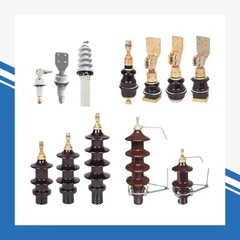
Anti-Fouling Porcelain Insulators are widely used in various power equipment, such as transformers, circuit breakers, surge arresters, disconnect switches and so on. With the continuous development of the power industry and the improvement of the reliability requirements of power equipment, the market demand for Anti-Fouling Porcelain Insulators is also increasing.
FAQ
As one of the leading anti-fouling insulator suppliers in China, we warmly welcome you to wholesale high-grade anti-fouling insulator made in China here from our factory. All our products are with high quality and competitive price.
vibration resistant insulation paper,