









Class 220 Polyester(imide) Overcoated with Polyamide-Imide Enamelled Aluminium Wire (EI/AIW/220, Q(ZY/XY)/L)
Class 220 is not the "better" version of Polyester(imide) Overcoated with Polyamide-Imide Enamelled Aluminium Wire, Class 200, and buying it by default is how money disappears from a bill of materials. It exists for one situation: a design where the calculated hot spot genuinely passes 200 °C and the only alternatives are a bigger core, a bigger enclosure or forced cooling that the customer will not accept.
This wire - EI/AIW/220, type Q(ZY/XY)/L, GB/T 23312.7, IEC 60317-25, NEMA MW 35-A - is the same two-layer construction as Polyester(imide) Overcoated with Polyamide-Imide Enamelled Aluminium Wire, Class 200 with a film system rated 20 K higher. Same conductor range, 0.20–6.00 mm. Same spools. The difference is only visible in the calculation and on the label.
What 20 K actually buys
A smaller core and tank at the same rating
If the permitted hot spot rises by 20 K, the losses the design can afford rise with it, and for a fixed cooling surface that means less iron and less copper - or, here, less aluminium. On a high-power-density transformer this is the whole commercial case. The metal you remove is worth more than the wire you upgrade.
Operation in an enclosure with no air movement
A reactor or transformer inside a sealed cabinet has conduction and radiation only. The winding sits where a ventilated design would never allow, and the calculation cannot be argued down by adding a fan that the enclosure does not have room for.
Tolerance of a high ambient design point
Rooftop, desert, tropical plant room, solar inverter cabinet in direct sun. When the ambient design point is 50 °C or above, 20 K of extra class is 20 K of load the unit can still carry.
Where it is specified
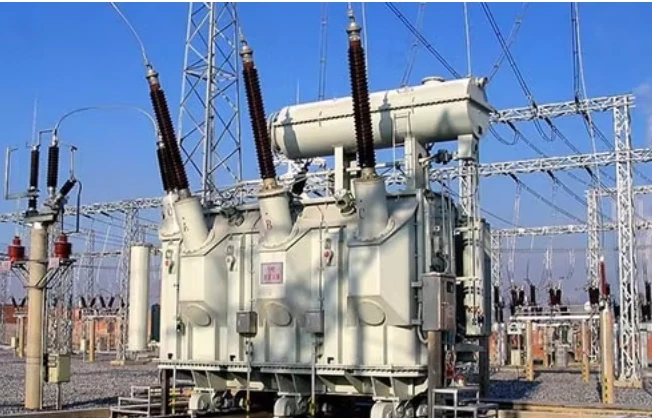
High-power-density transformers
The case is downsizing under a fixed enclosure. Distribution and small power transformers designed to run hot - because the customer wants the mass, the footprint or the cost out - land on class 220 when the hot-spot calculation refuses to close at 200 °C. The wire is the last component to become the constraint, which is why it is specified last and costs least in the sequence.
Dry-type units at class 220 sit above the designs on Class 180 Polyesterimide Enamelled Aluminium Round Wire (class 180, open-wound ventilated) and Polyester(imide) + PAI enamelled Al (class 200, cast-resin). If your winding is air-cooled with visible windings and a hot spot under 180 °C, none of these three pages is your answer -Class 180 Polyesterimide Enamelled Aluminium Round Wire is.
Inverter, reactor and PV / wind magnetics
An inverter reactor is the clearest case for this product in the renewable segment. Harmonic current concentrates loss, the enclosure is sealed against dust and weather, ambient inside a cabinet runs well above outdoor temperature, and the reactor has to ride through grid faults that push current far above rated for a few seconds.
A PV or wind converter cabinet is a hostile thermal environment for any winding: no forced air, high common-mode stress, continuous thermal cycling with the resource. Class 220 with a hard polyamide-imide surface is the practical specification when the reactor cannot be made bigger.
Severe-duty and explosion-proof motors
Motor windings in explosion-proof enclosures, high-temperature process areas, or machinery that is started and stalled repeatedly. The winding is thermally trapped by the enclosure and mechanically worked by the duty cycle; class 220 gives back the margin the enclosure took away.
Where the motor is aluminium-wound by design - weight-critical, or a market where aluminium is the established practice - this is the highest class available on aluminium in our range. Above it, Enamelled Aluminium Round Wire, Class 240 changes product family entirely and is built for voice coils, not motors.
Application
Specification
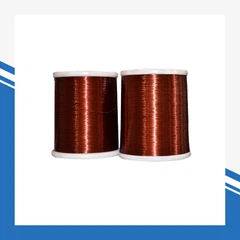
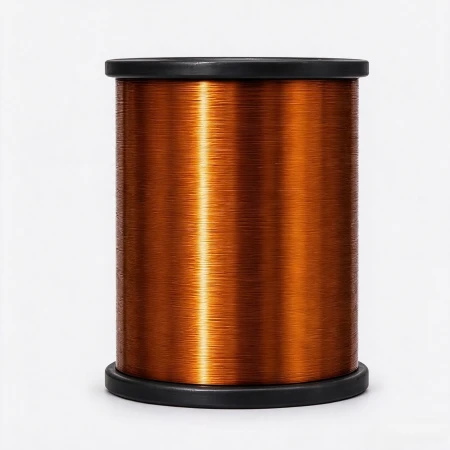
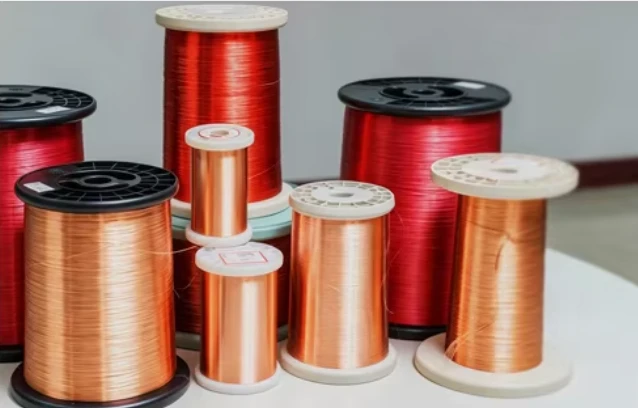
Caption: Class 220 enamelled aluminium wire (EI/AIW/220, Q(ZY/XY)/L) - two-layer construction, 0.20–6.00 mm.
| Item | Specification |
|---|---|
| Type designation | EI/AIW/220 - Q(ZY/XY)/L |
| Thermal class | 220 - Class C |
| Standard | GB/T 23312.7, IEC 60317-25, NEMA MW 35-A |
| Construction | Polyester(imide) base + polyamide-imide overcoat |
| Conductor | Aluminium, round, annealed |
| Size range | 0.20–6.00 mm |
| Properties | Thermal stability, high temperature resistance, high heat shock resistance, high mechanical strength |
| Enamel build | Grade 1, 2, 3 |
| Enamelling passes | 10–13, two-coat system |
| Spools | PT-25, PT-30, PT-35, PT-60, PT-90, PT-200, PT-270, wooden spool or customized on request |
| Typical applications | High-power-density transformers, inverter and reactor magnetics, PV and wind converter cabinets, severe-duty and explosion-proof motors |
Test schedule for every batch
Every delivery is accompanied by a batch test report. These are the tests it covers, and the limits applied are those of the standard quoted above:
| Group | Tests performed |
|---|---|
| Conductor | conductor diameter and tolerance, elongation, springback |
| Film | enamel build, continuity of covering, flexibility and adherence, heat shock, cut-through, scrape resistance, adhesion |
| Electrical | breakdown voltage, electrical resistance, tangent delta |
| Chemical | solvent resistance; refrigerant resistance where the application requires it |
The values are diameter-dependent, so they belong on the report for the size you buy rather than in a generic table. Ask for a sample report at your diameters before the first order.
VIdeo
Ordering, packaging and documentation
| Field | Meaning |
|---|---|
| EIAIW220 | Product and thermal class |
| 1.00 | Nominal conductor diameter, mm |
| G2 | Enamel build grade (G1 / G2 / G3) |
| PT200 | Spool type |
| 500 | Net mass per spool, kg |
Two part numbers, one warehouse. Class 200 and class 220 are indistinguishable on the spool, in store or on a hipot test. The difference is carried by the label, the batch record and the test report. If both are in your store, give them separate part numbers and separate locations - otherwise the upgrade exists only on paper.
Build grade. Grade 2 is the usual specification on aluminium; grade 3 where the bend radius is small or the turn-to-turn voltage is high.
Packaging. PT-25 to PT-270 and wooden spools as standard, 5–200 kg per package. Plastic spools and moisture-barrier packing with desiccant are available for sea freight.
Documentation. Batch test report with every delivery. Also available: type test report, PPAP, IMDS, material safety data sheet and material composition declaration.
Winding support. Aluminium is more sensitive to tension than copper. Send the diameter and machine type and we will give you a starting tension range and guide-wheel recommendation.
Product Series
our Cooperating customers

Certification

Hot Tags: polyester overcoated with polyamide-imide enamelled aluminium wire, China polyester overcoated with polyamide-imide enamelled aluminium wire suppliers, aerospace industry application of transformer winding, lighting service application of transformer winding, manual transformer winding, textile service application of transformer winding, winding leakage of transformer, winding temperature of transformer