








Class 200 Polyester(imide) Overcoated with Polyamide-Imide Enamelled Aluminium Wire
Aluminium is the reason this product exists.
Put copper on the enamelling line and a single polyesterimide coat does the job -Polyesterimide Enamelled Copper Wire, Class 180. Aluminium will not accept the same treatment. It yields earlier under winding tension, it expands about 35% more per kelvin than copper, and it arrives at the line carrying an oxide film that nothing bonds to easily. Each of those is a film problem, and the answer to all three is a two-layer insulation: a class 200 enamelled aluminium wire built as a polyester(imide) base with a polyamide-imide overcoat, designated EI/AIW/200, Chinese type code Q(ZY/XY)/L, in 0.20–6.00 mm.
Three properties of aluminium the film has to survive
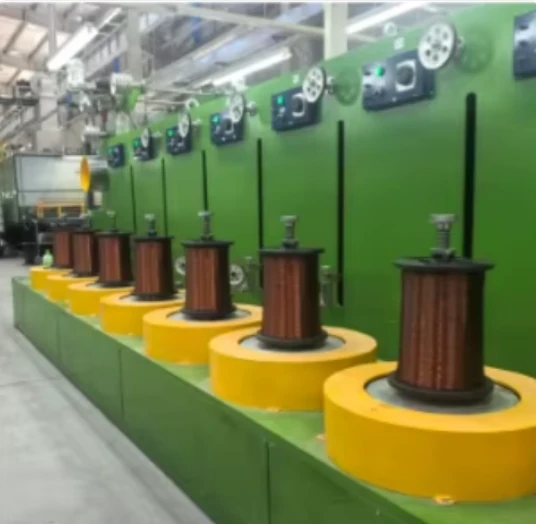
It yields before it breaks.
Aluminium's yield strength is roughly a third of copper's. Under the tension that a copper winding takes without complaint, an aluminium conductor deforms, and every deformation strains the film at the bend. The failure is not a broken wire - it is a film that has been stretched past its elongation and starts to craze where the turn leaves the slot.
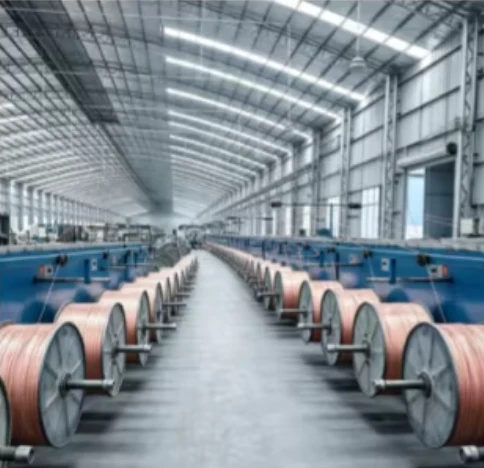
It moves more when it heats.
Thermal expansion of aluminium is 23 × 10⁻⁶/K against 17 × 10⁻⁶/K for copper - about 35% higher. On a winding that cycles between ambient and 180 °C, the conductor and the film move by different amounts at every cycle, and the film accumulates that difference as mechanical work. Eventually it cracks, and the crack is always at a bend.
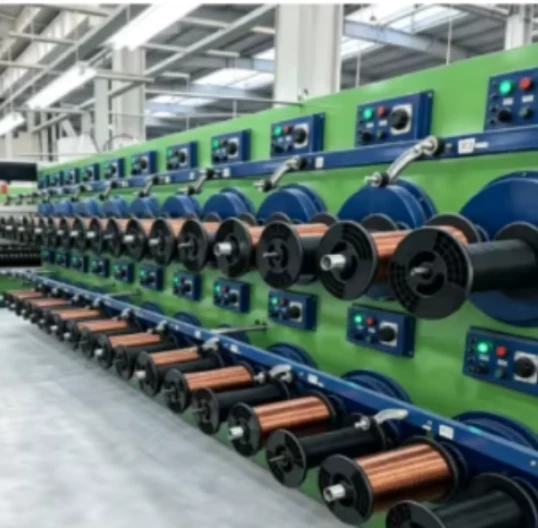
It oxidises.
An aluminium surface carries a thin oxide layer within minutes of being exposed. That layer is what the base coat has to bond through, and it is not uniform - which is exactly how a film ends up with pinholes and local lifts that no visual inspection finds.
Why two coats, and where the quality is decided
A single resin cannot do both jobs well. Formulated for adhesion and flexibility, it is soft at temperature and weak against solvents. Formulated for heat and chemical resistance, it does not bond to aluminium. The industry's answer - and ours - is to stop trying to do both with one resin:
Base coat - polyester or polyesterimide. Wets the metal, cures to a film that bends without lifting, and carries most of the dielectric body of the insulation.
Overcoat - polyamide-imide. Continuous operation at 200 °C, resistance to refrigerants and oils, high surface hardness against guide and slot abrasion, and high cut-through resistance under the pressure of adjacent turns.
The interface between the two is the part of the product a buyer cannot see, and it is where most of the engineering sits. Polyamide-imide adheres poorly to bare aluminium and well to a cured polyesterimide base, so the base coat has to be cured to the right degree: under-cured and the interface fails in service, over-cured and the base becomes brittle and takes the overcoat with it when the wire bends.
Two tests find that interface faster than any datasheet. Bend the wire on a mandrel and inspect the film at the bend for lifting rather than cracking. Heat-shock the sample and look for separation between the layers, not just for cracks in the outer film. Both are in the IEC 60317 schedule; both are worth running on the sample before you run them on a production lot.
Film is applied in 10–13 passes rather than a few heavy coats. Multiple thin passes build a denser film with fewer pinholes and less trapped solvent - which matters more on aluminium than on copper, because the oxide layer already gives the film a reason to fail locally.
Technical data sheet highlights
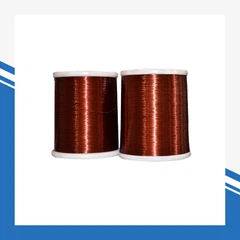
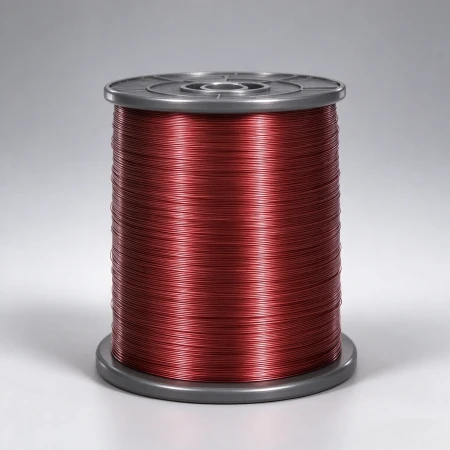
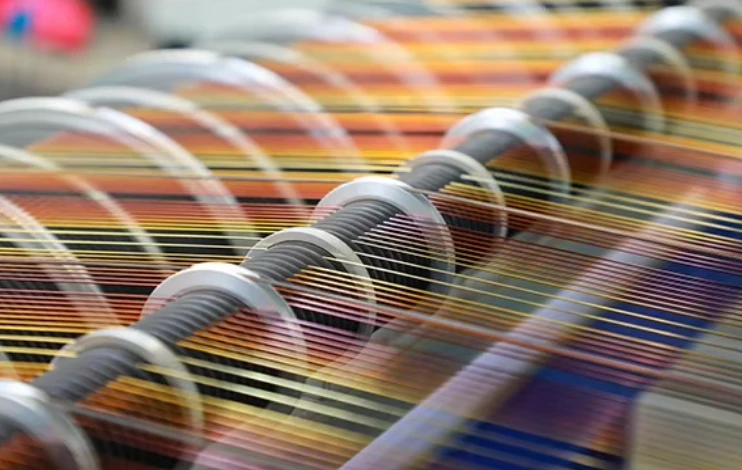
Caption: Class 200 enamelled aluminium wire (EI/AIW/200, Q(ZY/XY)/L) - two-layer construction, 0.20–6.00 mm.
| Item | Specification |
|---|---|
| Type designation | EI/AIW/200 - Q(ZY/XY)/L |
| Thermal class | 200 - Class C |
| Construction | Polyester(imide) base + polyamide-imide overcoat |
| Conductor | Aluminium, round, annealed |
| Nominal size range | 0.20–6.00 mm |
| Standard | GB/T 23312.7, IEC 60317-25, NEMA MW 35-A |
| Enamel build | Grade 1, 2, 3 |
| Enamelling passes | 10–13, two-coat system |
| Spools / net mass | PT-25, PT-30, PT-35, PT-60, PT-90, PT-200, PT-270 - 5 to 200 kg |
Test schedule for every batch
Every delivery is accompanied by a batch test report. These are the tests it covers, and the limits applied are those of the standard quoted for this product:
| Group | Tests performed |
|---|---|
| Conductor | conductor diameter and tolerance, elongation, springback |
| Film | enamel build, continuity of covering, flexibility and adherence, heat shock, cut-through, scrape resistance, adhesion |
| Electrical | breakdown voltage, electrical resistance, tangent delta |
| Chemical | solvent resistance; refrigerant resistance where the application requires it |
Products Display
Where class 200 is specified
Cast-resin and encapsulated transformers
The winding is encapsulated in epoxy or a similar resin, cured at temperature, and then it can never be inspected again. The film meets the resin and the hardener while the casting cures, and it meets them again at every load cycle as the encapsulated block expands and contracts around a conductor with a different expansion coefficient.
Two things follow for specification. First, resin compatibility is a pair decision: confirm the film against the actual resin and hardener system your casting shop uses, not against a generic claim. Second - and this is where class 200 earns its cost - the winding cannot be repaired, so any property that degrades slowly has to be specified with margin at the start.
Hermetic refrigeration and compressor motors
The motor runs inside a welded shell, in refrigerant and lubricant, and is never serviced. The failure mode is extraction: the film slowly loses low-molecular-weight fractions into the oil, becomes brittle and porous, and breaks down years later. The polyamide-imide surface is the barrier against that, which is why class 155 or 180 wire is the wrong answer here even when the winding temperature would allow it.
Qualification is by autoclave or extraction test with the actual refrigerant and the actual lubricant. Tell us the schedule before the order - the construction that passes one compressor maker's test is not automatically the one that passes another's.
Inverter, reactor and UPS magnetics
Losses concentrate. Skin and proximity effect push AC resistance well above the DC value, fringing flux at a gap induces eddy currents in the conductor, and the enclosure usually has no forced air. The winding sits hotter than the RMS current suggests, and it cycles with the switching load. Class 200 with a hard overcoat is the practical answer for a compact inverter reactor.
Open-wound, ventilated dry-type transformers sit below this product - that duty is served by P2 at class 180 and does not need a second coat. If your equipment is air-cooled with visible windings and a hot spot under 180 °C, P2 is the cheaper and correct specification, and we will say so.
VIdeo
Winding support
Aluminium is more sensitive to tension than copper, and the difference is large enough to cause breaks and film damage on a line set up for copper. Send the diameter and the machine type and we will give you a starting tension range and guide-wheel recommendation for your setup.
Application


our Cooperating customers

Certification

Hot Tags: polyester(imide) overcoated with polyamide-imide enamelled aluminium wire, China polyester(imide) overcoated with polyamide-imide enamelled aluminium wire suppliers, aerospace industry application of transformer winding, frequency of transformer winding, hospitality industry application of transformer winding, packaging service application of transformer winding, winding accuracy of transformer, winding temperature of transformer