

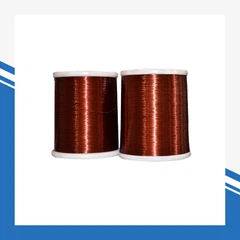









Class 180 Polyesterimide Enamelled Aluminium Round Wire (EIW/180, QZY/L)
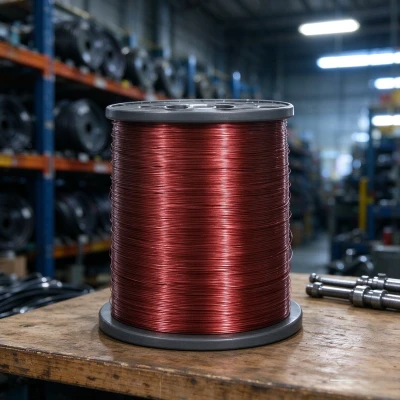
This is a class 180 enamelled aluminium round wire - designated EIW/180, Chinese type code QZY/L, a thermal class H winding wire supplied on a round aluminium conductor from 0.20 mm to 6.00 mm. It is made to GB/T 23312.5, IEC 60317-15 and NEMA MW 76-A. The decision that matters is the life expectancy of the winding at its actual hot-spot temperature; run that calculation and "class 180" stops being a preference and becomes a number with a cost attached.
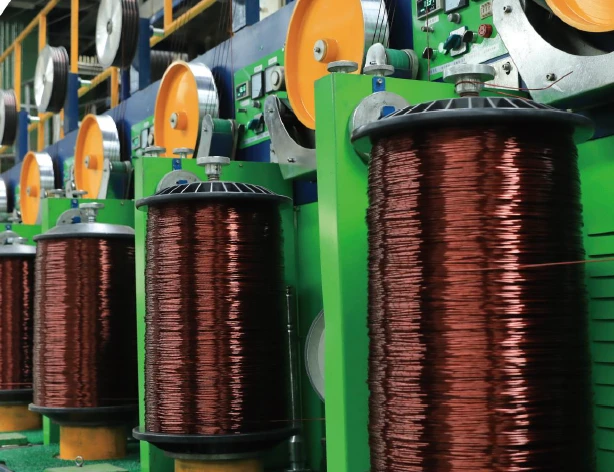
Why 25 K changes the purchase
Thermal ageing of an organic film follows an Arrhenius relationship: in the working range of magnet wire, a sustained 8–10 K reduction in temperature roughly halves the rate of degradation. Read the other way, a winding rated for a 180 °C hot spot tolerates duty that would consume a class 155 winding in a fraction of its design life.
The 25 K between P1's 155 and this wire's 180 is therefore not a label difference. It is the difference between a winding that still has margin after five years of load growth and one that does not.
Polyesterimide rather than polyester
The resin change does more than move a temperature class. Polyesterimide lifts three properties at once, and on a transformer all three are load-bearing:
Cut-through resistance. The cured film resists displacement under the pressure of adjacent turns at temperature - the exact condition created by short-circuit forces.
Solvent resistance. The film resists transformer oil and the solvents in impregnating varnish better than a polyester film, so the winding does not soften after the varnish bake. This is the property the catalogue lists for EIW/180 and does not list for the polyester PEWA grades.
Heat shock. After rapid heating and cooling the film stays wrapped instead of cracking at the bend, which is where most turn-to-turn faults begin.
Products Display
Technical data sheet highlights
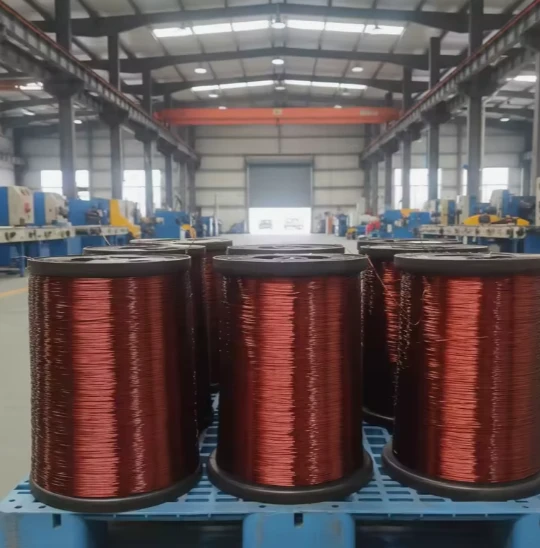
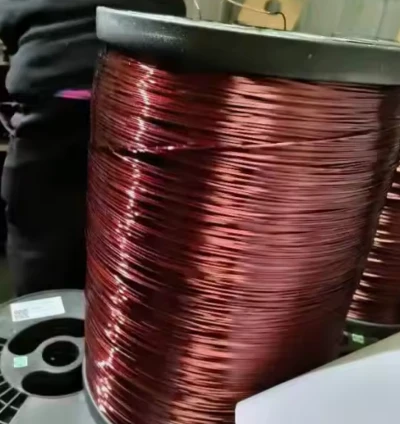
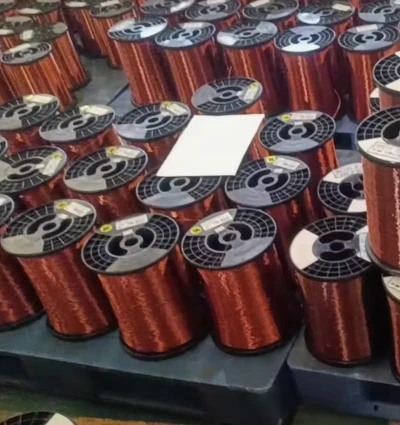
Caption: Class 180 enamelled aluminium round wire (EIW/180, QZY/L) - construction and dimensional limits to IEC 60317-0-3.
| Item | Specification |
|---|---|
| Type designation | EIW/180 (QZY/L) |
| Thermal class | 180 - Class H |
| Conductor | Aluminium, round, annealed |
| Nominal size range | 0.20–6.00 mm |
| Standard | GB/T 23312.5, IEC 60317-15, NEMA MW 76-A |
| Enamel build | Grade 1, 2, 3 |
| Enamelling passes | 10–13 |
| Spools / net mass | PT-25 to PT-270, wooden or to customer request - 5 to 200 kg |
| Thermal endurance | Class 180, correlated per IEC 60216 |
VIdeo
what actually changes between polyester Enamelled Aluminium wire and Polyesterimide Enamelled Aluminium wire
Same conductor, same size range, same spool programme, same enamelling lines. The difference is the resin and everything the resin decides.
| Polyester PEWA130/155 | Polyesterimide EIW/180 | |
|---|---|---|
| Enamel | Modified polyester | Polyesterimide |
| Thermal class | 130 / 155 (B / F) | 180 (H) |
| Cut-through at temperature | Lower | Higher |
| Oil and varnish solvent resistance | Moderate | Better - listed in the specification |
| Heat shock | Standard | High |
| Cost per kg | Lower | Higher |
| Winding regime | High-volume, cost-driven | Margin-driven, robustness-driven |
Where the applications diverge
polyester Enamelled Aluminium wire is bought by appliance motor lines and small distribution transformer builders. The design has already established that the hot spot stays inside 130 or 155 °C, the winding is wound fast in high volume, and the purchasing decision is dominated by cost per kilogram. Nothing about the application asks the film to do anything unusual.
Polyesterimide Enamelled Aluminium wire is bought by transformer designers and by motor engineers whose winding runs hotter than a class F machine. Four situations send a buyer from Polyester and Polyesterimide enamelled aluminium wire, and they are all worth naming:
The hot spot is between 155 and 180 °C. Common on distribution transformers loaded above nameplate, and on small dry-type units in poor ventilation.
The winding is varnish-impregnated or oil-immersed. Solvent resistance after the bake is the deciding property, not the temperature class.
The fault level is high. Cut-through, not dielectric strength, is what fails a winding under short-circuit forces.
The unit is exported to a hot climate. A 40 °C ambient assumption becomes 50 °C, and 25 K of margin disappears.
Conversely, if the hot spot stays under 140 °C on an appliance motor wound at 4,000 stators a shift, P2 is money spent on a property the application cannot use.
Three duties this wire is bought for
Class 180 is not a general upgrade. It is bought for three specific duties, and if your winding is not one of them, P1 does the same job for less money.
1. Distribution transformer overload margin
A distribution transformer rarely spends its life at the number on its nameplate. Demand grows, and the loading guides (IEC 60076-7) permit emergency overload within limits set by hot-spot temperature and loss of insulation life. Those limits are where the wire class turns into a commercial constraint.
On a class 155 winding the permitted hot spot is already close to the operating point after a few years of load growth, so every overload event spends life that was never budgeted. On class 180 the same event is absorbed inside the margin - 25 K of headroom between the normal operating hot spot and the class limit, available for the year the load arrives.
What to check before specifying: the calculated hot-spot temperature at rated load, the ambient design point, and whether cooling is ONAN or ONAF. If the hot spot at rated load already sits above 140 °C, a class 155 winding leaves nothing for the overload the utility will eventually apply.
Buying signal: a specification that names class 180 - or "class H" - for a distribution transformer is asking for this margin. It is not asking for a temperature to print on a datasheet.
2. Short-circuit shear in dry-type windings
A through-fault puts the winding under radial and axial forces proportional to the square of the current. In an oil-immersed unit those forces are partly damped by the liquid. In a dry-type winding, ventilated or resin-encapsulated, the turns are held by the conductor, the film and the impregnation - nothing else.
The failure is usually not a flashover. It is cut-through: adjacent turns press together, the softened film is displaced, two turns touch, and the winding now has a shorted turn that no routine factory test will find until it overheats in service.
Three properties decide that outcome, and all three appear in the EIW/180 specification:
Cut-through resistance at temperature - the film must not yield under the pressure of the turn beside it.
Heat-shock resistance - after the fault heats the winding and it cools, the film must not crack at the bend.
Adhesion - the film must stay on a conductor that has just been strained.
Aluminium makes all three harder. The conductor yields more under force, so the film is worked harder at every turn. That is why a class 180 aluminium winding is normally specified at grade 2 or grade 3 build rather than grade 1: on this duty the extra film thickness is structural, not decorative.
Dry-type transformers are classified by thermal class under IEC 60076-11, and class 180 is a standard designation in that family. Above it, the next step is class 200 - which is Polyester(imide) Overcoated with Polyamide-Imide Enamelled Aluminium Wire.
3. Transformer oil and impregnating varnish
Two chemical exposures, years apart, both decided by the film.
Oil. An oil-immersed winding sits in hot mineral oil for twenty-five years. The film must not soften, swell, or lose low-molecular-weight fractions into the oil. Extraction is slow and invisible: the winding passes every factory test and fails a decade later, in a unit nobody can open.
Varnish. Impregnation exposes the film to solvent. An enamel that resists heat but not solvent softens during the bake, and the softening shows up later as reduced cut-through and a winding that no longer holds its geometry.
This is the clearest specification difference between Polyester Enamelled Aluminium Round Wire, Class 180 and Polyesterimide Enamelled Aluminium Round Wire, Class 180. The catalogue lists solvent resistance for EIW/180 and does not list it for the polyester PEWA grades. If the winding will be varnished or oil-immersed, that line in the specification is the one to read - not the temperature class.
Application


our Cooperating customers

Certification

Hot Tags: polyesterimide enamelled aluminium round wire, class 180, China polyesterimide enamelled aluminium round wire, class 180 suppliers, flux density of transformer winding, mining application of transformer winding, telecommunication industry application of transformer winding, transformer winding assembly, winding consistency of transformer, winding leakage of transformer