










Polyester Enamelled Aluminium Round Wire, Class 130/155
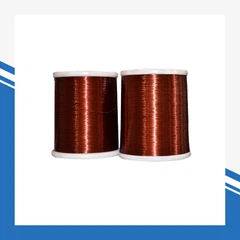
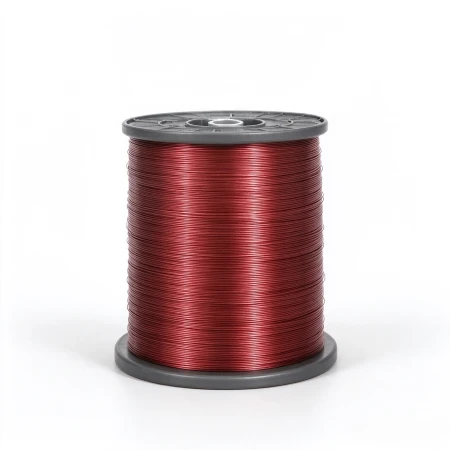
Two thermal ratings, one enamel system, one production line. PEWA130 and PEWA155 are the same modified polyester enamel on the same aluminium conductor - the 155 version uses a resin modification that lifts the continuous rating by 25 K. Everything else, from the 0.20–6.00 mm size range to the spool programme, is identical.
That is deliberate. It means a customer building both a class 130 fan motor and a class 155 pump motor can buy one product family, hold one set of incoming inspection limits, and change the thermal class with a single field on the order.
What the aluminium conductor changes
An aluminium winding needs roughly 1.6 times the cross-section of a copper winding for the same resistance, and weighs about half as much. In a distribution transformer that trade converts into a lighter core-and-coil, a lighter tank, and a lower transport cost. In an appliance motor it converts into a stator designed around a larger slot.
Either way the enamel meets a different mechanical regime than it would on copper. Aluminium is softer; it deforms more under winding tension, and the film takes more of the load at every bend. That is why this product is normally specified at grade 2 build rather than grade 1 - the extra film thickness is mechanical protection, not dielectric margin.
Where "modified" earns its place
A straight polyester enamel is a class 130 material. Reaching 155 without changing the application process means modifying the resin so the cured film resists thermal degradation for longer at the higher temperature. The catalogue properties for both ratings are the same: good heat resistance, abrasion resistance, good adhesion.
In service the three properties map onto three failure modes:
Heat resistance - the winding survives the continuous hot spot, and the varnish bake afterwards.
Abrasion resistance - the film survives the guides, the felt and the slot entry during winding.
Adhesion - the film stays on the metal when the wire is bent at the lead, which is where most turn-to-turn faults begin.
Technical data sheet highlights
Construction and dimensions
| Item | PEWA130 | PEWA155 |
|---|---|---|
| Type designation | PEWA130 | PEWA155 |
| Thermal class | 130 (Class B) | 155 (Class F) |
| Conductor | Aluminium, round, annealed | Aluminium, round, annealed |
| Nominal size range | 0.20–6.00 mm | 0.20–6.00 mm |
| Standard | GB/T 23312.3, NEMA MW 24-A | GB/T 23312.3, NEMA MW 24-A |
| Enamel build | Grade 1, 2, 3 | Grade 1, 2, 3 |
| Enamelling passes | 10–13, single enamel system | Same |
| Spools / net mass | PT-25, PT-30, PT-35, PT-60, PT-90, PT-200, PT-270 - 5 to 200 kg | Same |
Dimension limits per IEC 60317-0-3. Extract at four reference diameters (mm):
| Nominal | Tolerance | Min. enamel G1 | Min. enamel G2 | Min. enamel G3 | Max. OD G1 | Max. OD G2 | Max. OD G3 |
|---|---|---|---|---|---|---|---|
| 0.500 | ±0.005 | 0.024 | 0.045 | 0.067 | 0.544 | 0.566 | 0.587 |
| 1.000 | ±0.010 | 0.034 | 0.063 | 0.095 | 1.062 | 1.094 | 1.124 |
| 2.500 | ±0.025 | 0.042 | 0.079 | 0.119 | 2.587 | 2.618 | 2.656 |
| 6.000 | ±0.060 | 0.060 | 0.097 | 0.152 | 6.093 | 6.141 | 6.186 |
The gap between G1 and G3 on a 1.00 mm conductor is 0.061 mm per turn - over 1.2 mm on a twenty-layer coil. That is the number to check against your winding window before you fix the build grade.
Electrical and mechanical characteristics
| Property | Test basis |
|---|---|
| Elongation at break | IEC 60317-0-3 mechanical schedule |
| Springback | as above, springback test |
| Breakdown voltage, G1 / G2 / G3 | as above, at 1.000 mm |
| Cut-through temperature | as above |
| Heat shock | 30 min at class temperature + 25 K |
| Flexibility and adherence | mandrel bend, 1 × d |
| Continuity of covering | low-voltage continuity |
| Thermal endurance | IEC 60216 correlation |
Why each row matters to a designer
Elongation is measured on the annealed conductor, not on the finished wire, and it is the number that decides whether the wire survives being drawn down and then bent. Aluminium is softer than copper, so this is the first figure a motor designer asks for - and the first one an incoming inspection department tests.
Springback governs coil forming. A higher springback angle means the coil opens after the winding head releases it, which shows up as a loose coil and a slot-fill problem rather than as a wire fault.
Breakdown voltage is quoted by build grade because the three grades differ in film thickness, not in enamel quality. Specify the grade, then read the voltage.
Cut-through is the property that decides whether the winding survives a short circuit. It rises with thermal class, which is the real engineering difference between the 130 and 155 versions - not just a label.
Products Display


VIdeo
Target applications
The catalogue describes this wire broadly as "general household appliance motors, power transformers". In practice it is specified into three groups, and the class choice differs between them.
Appliance motors
Washing machine motors - sealed, humid, continuous duty; normally class 155
Air-conditioner fan motors - low load, long hours; class 130 or 155
Pump motors - sealed and continuous; class 155
Range hood and ventilation fans - moderate ambient; class 130
Power distribution equipment
Small oil-immersed distribution transformers - class 155 is the mainstream choice
Dry-type transformers in the smaller ratings - class 155, where the ambient stays controlled
Instrument and auxiliary transformers - fine diameters, class 130
Other coil work
Ballasts and small chokes
Micro motors and shaded-pole motors
Power supply and control transformers
Application


Aluminium instead of copper: where the money actually is
Three arguments bring buyers to PEWA, and they are not equally strong.
Material cost and copper price exposure. Aluminium converts at a lower cost per unit of conductance, and it decouples the bill of materials from a metal whose price moves faster than most purchasing departments can hedge. For a transformer builder working to a fixed-price contract, that predictability is often worth more than the saving itself.
Mass. Roughly half the weight for the same resistance. On a distribution transformer that cascades: lighter core-and-coil, lighter tank, lighter transport, lower erection cost. On a pole-mounted unit it can decide whether the installation is a two-man job or a crane job.
Process compatibility - with conditions. The winding equipment and the enamelling route do not change. What does change, and has to be planned:
Tension settings. Aluminium is softer and deforms more, so a tension that suited copper will over-strain it.
Springback. Different from copper, so coil-forming tooling may need adjustment.
Slot geometry. If you keep the same rating, the slot must accept about 1.6 times the conductor area. That is a design change, not a settings change.
Termination. Aluminium is brazed, not soldered. A line set up for solder joints needs a process step added.
Saying this plainly costs us the occasional order from a buyer who wanted a drop-in replacement. It saves the customer a failed first build, which is worth more.
Product family
We have enamelled wire family product, you can choose
| Product | Class | Conductor | Size | Page |
|---|---|---|---|---|
| Polyester (modified) enamelled round wire | 130 / 155 | Aluminium | 0.20–6.00 | this page |
| Polyesterimide enamelled round wire | 180 | Aluminium | 0.20–6.00 | Class 180 aluminium wire |
| Polyester(imide) + polyamide-imide enamelled wire | 200 | Aluminium | 0.20–6.00 | Class 200 aluminium wire |
| Same construction, higher class | 220 | Aluminium | 0.20–6.00 | Class 220 aluminium wire |
| High-temperature enamelled round wire | 240 | Aluminium | 0.50–4.00 | Class 240 aluminium wire |
| Polyester enamelled round wire | 130 / 155 | Copper | 0.08–3.50 | Class 130/155 copper wire |
| Polyesterimide enamelled round wire | 180 | Copper | 0.08–3.50 | Class 180 copper wire |
| Polyester(imide) + polyamide-imide enamelled wire | 200 / 220 | Copper | 0.08–3.50 | Class 200/220 copper w |
our Cooperating customers

Certification

Hot Tags: polyester enamelled aluminium round wire, China polyester enamelled aluminium round wire suppliers, lighting service application of transformer winding, mining application of transformer winding, security service application of transformer winding, transformer winding assembly, winding inductance of transformer, winding temperature of transformer