










Description
36 kV T Surge Arrester - Deadfront Overvoltage Protection for 36 kV Class Apparatus
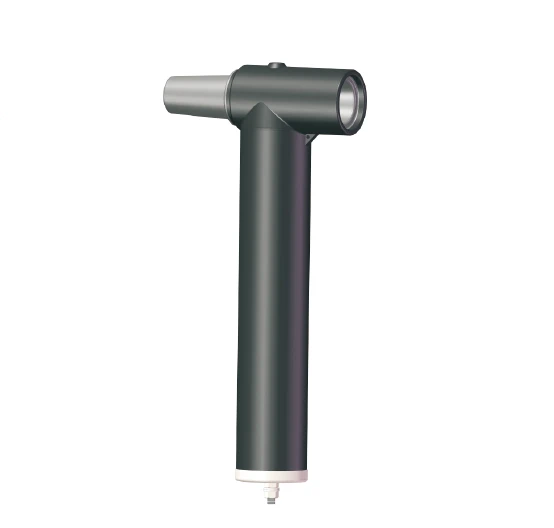
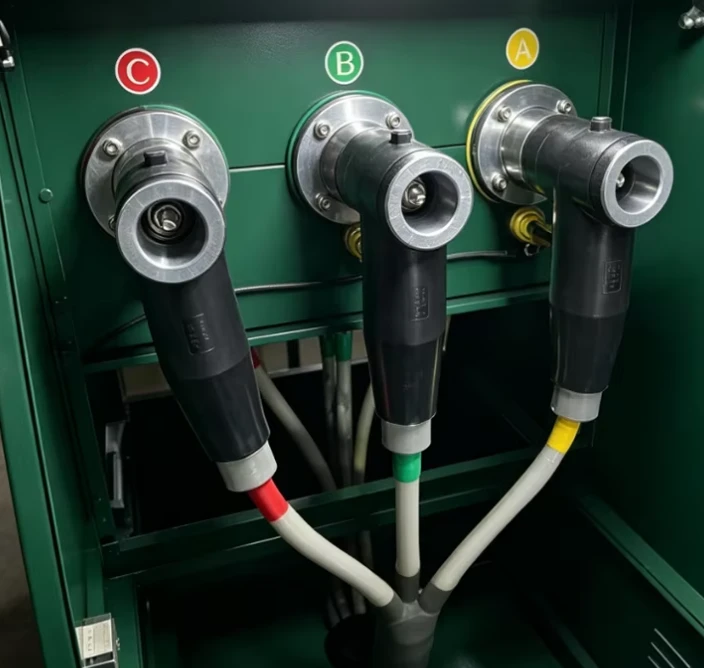
The 36 kV T surge arrester protects 36 kV class transformers, equipment, cable and cable accessories against high-voltage surges caused by lightning or switching. It plugs into the rear leg of an EN 36-630 separable tee connector, so surge protection is added at the exact point where the cable terminates - deadfront, fully shielded, and touch-safe.
Its core is a gapless metal-oxide varistor (MOV) stack, moulded inside peroxide-cured EPDM to form a single compact body with no minimum phase-clearance requirement. The result is a plug-in arrester that fits where conventional gapped arresters cannot: tight switchgear compartments, compact substations, and crowded 36 kV cable termination chambers.
The protective window: how a 36 kV arrester is chosen
An arrester is not specified by voltage class alone - it is specified by the window it must sit inside, and two numbers define that window:
MCOV (Maximum Continuous Operating Voltage) is the lower boundary. The arrester must never conduct at normal system voltage, so MCOV must be at least the network's maximum continuous phase-to-ground voltage.
Residual (protective) voltage is the upper boundary. When a surge arrives, the arrester clamps the voltage to this level - which must stay below the impulse withstand of the equipment you are protecting (the transformer winding, the cable, the switchgear insulation).
Every 36 kV T surge arrester is therefore chosen from the selection matrix in the next section: read across from your duty voltage, confirm the MCOV clears your earthing arrangement, then confirm the residual voltage clears your equipment's withstand. Steady-state and surge performance are set by the same matched element pair, so the protected equipment always sees a coordinated response.
Protective characteristics
| Voltage rating (kV) | MCOV (kV) | Residual voltage - lightning, 5 kA (kV) | Residual voltage - lightning, 10 kA (kV) |
|---|---|---|---|
| 11 | 9.3 | 33 | 33 |
| 12 | 10.2 | 36 | 36 |
| 15 | 12.7 | 45 | 45 |
| 18 | 15.3 | 54 | 54 |
| 21 | 17 | 63 | 63 |
| 24 | 19.5 | 72 | 72 |
| 27 | 22 | 81 | 81 |
| 30 | 24.4 | 90 | 90 |
| 33 | 27.5 | 99 | 99 |
| 36 | 29 | 108 | 108 |
| 39 | 31.5 | 117 | 117 |
| 42 | 34 | 126 | 126 |
| 45 | 36.5 | 135 | 135 |
| 48 | 39 | 144 | 144 |
| 51 | 40.8 | 134 | 144 |
Inside the arrester:
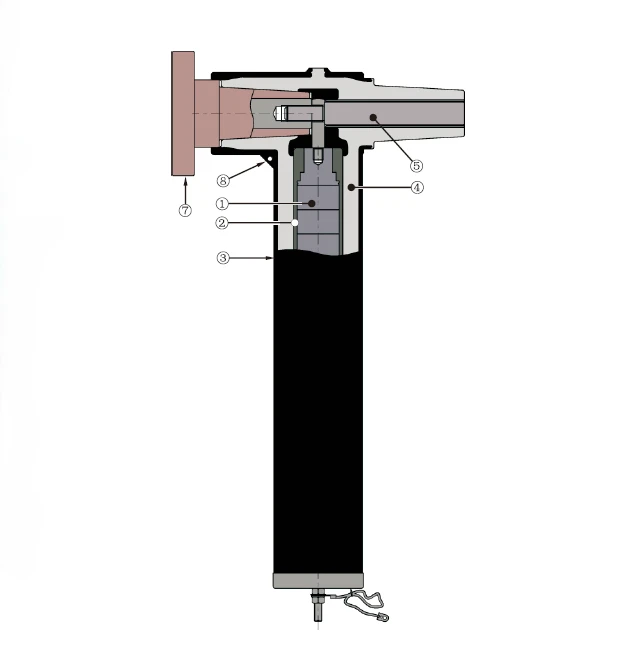
The arrester is built as three functional subsystems working as one - the resistive core that does the work, the dielectric envelope that keeps the field controlled, and the connection & grounding path that completes the installation.
Resistive core
Metal-oxide resistor elements - the active element: a two-terminal resistive block made from an electronic semiconductor with suitable contacts, exhibiting a markedly non-linear volt-ampere characteristic. This is what conducts only above the protective level.
Dielectric envelope (keeps the surface corona-free)
Semiconducting insert - precision-moulded, peroxide-cured semiconducting insert gives corona-free electrostatic shielding of the compression connector.
Semiconducting shield - precision-moulded, peroxide-cured semiconducting shield maintains ground-shield continuity along the whole body.
Insulation layer - high-quality peroxide-cured EPDM, mixed and formulated in-house so the dielectric properties are under the maker's own control.
Bushing - the moulded interface through which the live conductor passes.
Connection & grounding path
Connecting rod - copper rod that locates and connects the arrester during installation.
Conductive rubber cap - completes the grounding system.
Drain wire tab - a dedicated point to land the drain (earth) wire, ensuring the connector shield is grounded.
Because the semiconducting layers are peroxide-cured and moulded into the EPDM, the body is void-free and fully screened - the source of both the low partial-discharge performance and the "no phase clearance" claim.
Key features
Fully shielded deadfront protection - no exposed live parts; safe in compact enclosures.
Gapless metal (zinc) oxide varistor (MOV) design - a stable protective level with no spark gaps to wear, erode or drift.
EPDM insulation moulded around the MOV module - a sealed dielectric that resists moisture ingress.
No minimum phase-clearance requirement - arresters can be grouped tightly in 36 kV apparatus.
100% electrical tested at factory - consistent, unit-by-unit verification.
Plug-in companion to the EN 36-630 connector - protection added at the termination, not somewhere down the cable.
Where 36 kV class networks use a deadfront arrester
This is a deadfront protective device for 36 kV class apparatus. Its plug-in format makes it the natural choice wherever an EN 36-630 separable tee connector is used on a 33–36 kV network.
Substation transformers and primary switchgear
On a 36 kV primary substation, an incoming cable feeds the transformer and the busbar through deadfront apparatus. A 36 kV T arrester at that bushing clamps the surge at the termination, so the transformer winding, the cable end and the switchgear insulation share one protective zone instead of relying on a remote line arrester.
33–36 kV cable terminations on the EN 36-630 platform
Wherever a 33–36 kV cable is terminated on a separable tee connector, the arrester plugs straight into the rear leg. It protects the connector, the compression lug and the cable insulation at the termination - the point of highest surge reflection and stress - without any additional cable termination work.
Heavy-industry captive 36 kV networks
Steel works, cement plants, mines, ports and large process plants run their own 36 kV distribution, often fed from long overhead lines or exposed feeders. Deadfront arresters at the main incoming transformer and 36 kV switchgear limit surge damage to transformers, motors' feeders and switchgear in environments where unplanned downtime is expensive.
36 kV wind and solar collector substations
Renewable collector networks gather many feeders into one substation and their long cable runs collect induced surges. A 36 kV T arrester at the collector transformer and switchgear interface protects the MV side of the network, where the plant's energy export depends on it.
36 kV ring main units and compact substations
Modern 36 kV RMUs and compact/pad-mounted substations have very tight phase spacing. Because the arrester is fully screened and needs no minimum phase clearance, it can be fitted inside enclosures where conventional gapped arresters would not physically or electrically fit - keeping the footprint small.
Network reinforcement and retrofit on existing 36 kV points
Because it plugs into the rear leg of an existing EN 36-630 connector, the arrester can be added during a reinforcement project or as a retrofit to an unprotected deadfront point - without re-terminating the cable. It is the fastest way to raise the surge withstand of an existing 36 kV network.
Product display


Kit contents
Each Rear T-Body Surge Arrester kit is supplied in a heavy-duty polyethylene bag and contains:
Rear T-Body surge arrester
Stud (double-ended threaded stud)
Connecting rod
Silicone lubricant
Installation instruction sheet
Clean paper / cleaning wipe

FAQ
Q. How do I choose a 36 kV T surge arrester?
Work the protective window: pick the duty voltage rating that matches your network, confirm its MCOV clears your maximum continuous phase-to-ground voltage, then confirm its residual voltage at 5 kA / 10 kA is below the impulse withstand of the equipment you are protecting.
Q. What is the difference between MCOV and residual voltage?
MCOV is the highest continuous voltage the arrester tolerates without conducting - the lower boundary. Residual voltage is the level it clamps a surge to - the upper boundary. A correct design keeps the arrester quiet below MCOV and clamps below the equipment's withstand.
Q. Why is residual voltage quoted at both 5 kA and 10 kA?
Because the protective level is a function of the discharge current. Quoting both lets you check the margin at either coordination current, rather than assuming a single fixed clamping level.
Q. What is a "T" surge arrester and where does it mount?
It is a deadfront, separable arrester whose body plugs into the rear leg of a T (tee) separable connector. On this platform it mates with the EN 36-630 connector, so protection arrives at the cable termination point.
Q. Does it need a minimum phase clearance or a mounting bracket?
No. It mounts directly on the connector and, being fully shielded, requires no minimum phase clearance - it fits compact 36 kV apparatus.
Q. Is it suitable for outdoor, humid or coastal sites?
Yes. The peroxide-cured EPDM body is moulded around the MOV stack as a sealed, void-free dielectric, so it resists moisture ingress in outdoor and coastal service.
Q. Is a 36 kV arrester ever used on a 33 kV system?
Yes - 36 kV is the equipment class for 33 kV networks. Select the duty-voltage row against your earthing arrangement (effectively grounded vs non-effectively grounded changes the required MCOV), not against the nominal 33 kV figure alone.
Q. Is it compatible with third-party connectors?
It is designed for the EN 36-630 separable tee connector platform. Confirm your connector interface before ordering.
Hot Tags: 36kv t surge arrester, China 36kv t surge arrester suppliers, transformer performance, transformer prices, transformer rectifiers, transformer sales, transformer scramblers, transformer wireless access points