











Description
24 kV 250A Deadbreak Elbow - Type A 90° Cable Termination with Hold-Down Bails
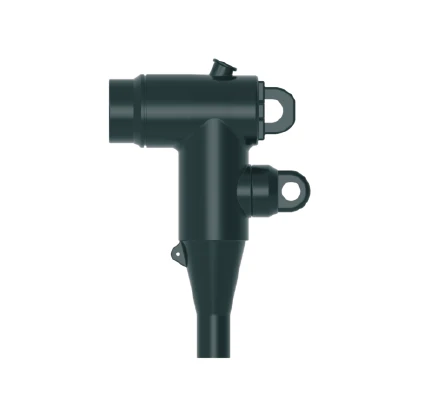
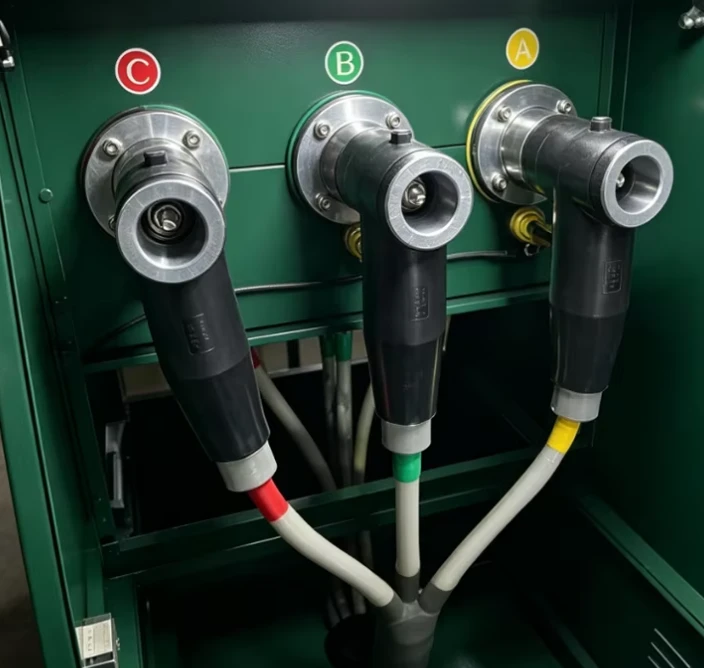
The 24 kV 250A deadbreak elbow is a fully shielded and insulated termination for connecting underground cable to transformers, switchgear and other apparatus equipped with deadbreak bushings, junctions or other deadbreak connectors. Its body turns the cable through 90°, so the cable leaves the apparatus at a right angle instead of straight out - the form that fits confined termination chambers.
The elbow meets all the requirements of EN 50180, EN 50181 and IEC 60502, and is designed to be fully interchangeable with competitor products and mating products that meet EN 50180 / EN 50181.
Why the form matters: the 90° elbow
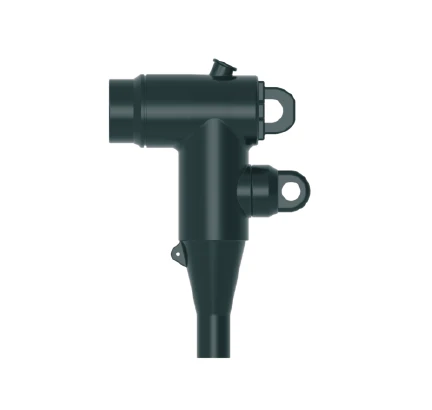
A separable termination has to reach a deadbreak interface without clashing with everything around it. Where the cable approaches parallel to the apparatus face, or where there is no room straight ahead, the elbow turns the cable 90° at the interface and routes it away along the apparatus - keeping bending radius intact and the termination chamber clear. Combined with a fully shielded, dead-front body, it gives a right-angle joint that is both compact and touch-safe.
Interchangeability on the EN 50180 / EN 50181 interface
Meets EN 50180, EN 50181 and IEC 60502.
Fully interchangeable with competitor products and any mating product meeting EN 50180 / EN 50181.
Bi-metal compression connector as standard (copper and aluminium conductors); optional copper connector for copper-only cable.
Construction
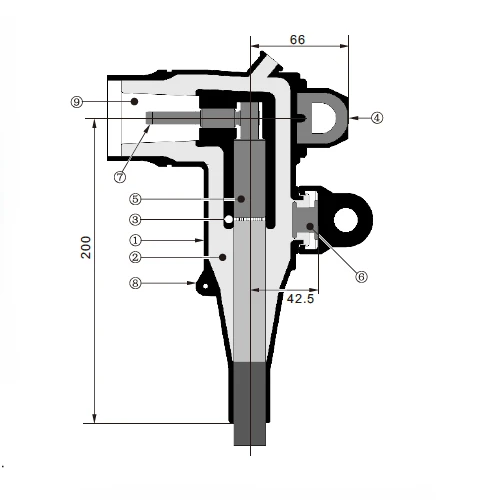
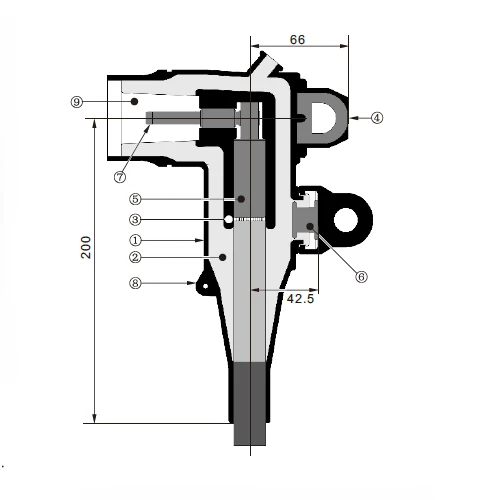
Semiconducting shield - a precision-moulded, peroxide-cured shield that maintains ground-shield continuity and meets the requirements of IEEE Standard 592.
Insulation layer - peroxide-cured EPDM, formulated in-house for full control of the rubber's characteristics.
Semiconducting insert - precision-moulded, peroxide-cured insert giving corona-free electrostatic shielding of the compression connector.
Operating eye - an integral feature of the elbow body, designed to assist the hold-down bails in fixing the elbow.
Compression connector - Bi-metal (standard) or optional copper, sized for a cool-running joint with maximum current transfer.
Capacitive test point - on the moulded body with a snap-on cap; shielded and hot-stick operable for checking circuit condition.
Pin probe - a tin-plated copper probe that supports dependable switching operations.
Drain wire tab - a convenient point to connect the drain wire and ensure grounding of the connector shield.
Operating interface - Type A, 250A interface as described by EN 50180 and EN 50181.
Rated performance
| Parameter | Value |
|---|---|
| Voltage class | 24 kV |
| AC withstand, 5 minute | 54 kV |
| BIL and full-wave crest | 125 kV |
| Partial-discharge minimum extinction voltage | 20 kV |
| Thermal short circuit (conductor, 2 sec) | 23 kA / 2 s |
| Dynamic short circuit (conductor, 10 sec) | 82 kA / 10 ms |
| Screen leakage current | ≤ 0.5 mA |
Cable range and conductor selection
The elbow covers cable insulation diameters from 17.6 mm to 32.5 mm (five range codes) and conductor sizes from 25 mm² to 120 mm² (seven conductor codes).
Cable range codes (by cable insulation outer diameter)
| Cable range code | Inches | Millimetres |
|---|---|---|
| A | 0.693–0.850 | 17.6–21.6 |
| B | 0.740–0.913 | 18.8–23.2 |
| C | 0.810–1.031 | 21.6–26.2 |
| D | 0.969–1.123 | 24.6–28.7 |
| E | 1.134–1.280 | 28.8–32.5 |
Conductor codes
| Conductor code | AWG or kcmil | mm² |
|---|---|---|
| 01 | 3 | 25 |
| 02 | 2 | 35 |
| 03 | 1/0 | 50 |
| 04 | 2/0 | 70 |
| 05 | 3/0 | 95 |
| 06 | 4/0 | - |
| 07 | 250 | 120 |
The kit
Each elbow kit is supplied in a heavy-duty polyethylene bag and contains:
Standard elbow body
Loadbreak probe
Bi-metal or copper compression connector
Hex wrench
Hold-down bails (1 bail standard, or 2)
Silicone lubricant
Installation instruction sheet
Clean paper
Product display


Where the elbow is used
Underground cable to transformers in tight chambers
Where an underground MV cable rises into a transformer's deadbreak bushing but cannot run straight out - pad-mounted and compact substations where space behind the bushing is limited - the 90° elbow turns the cable away and keeps the termination chamber clear.
Underground cable to switchgear
Connecting cable into switchgear equipped with deadbreak bushings or junctions, where the cable approach needs a right-angle turn at the interface.
Apparatus fitted with deadbreak bushings, junctions or deadbreak connectors
A general mating termination for any apparatus that presents a conforming deadbreak interface - bushings, junctions or other deadbreak connectors.
Cable-jointing, switching and maintenance work
Because it is fully shielded, dead-front and intermateable, and is fitted with a pin probe, the elbow is suited to jointing and maintenance programmes where cable must be connected to, or switched on, existing EN 50180 / EN 50181 apparatus.

FAQ
Q. What is a deadbreak elbow?
A fully shielded, insulated 90° separable cable termination - cable in on one side, deadbreak interface on the other - used to connect underground cable to apparatus fitted with deadbreak bushings, junctions or connectors.
Q. How is it different from a straight receptacle?
A straight receptacle makes an in-line joint; the elbow turns the cable 90° at the interface, which suits confined termination chambers. Both are 250A (Type A) on this datasheet.
Q. What are the hold-down bails for?
They fix the elbow onto its interface - the elbow is anchored by the bail system, not by the cable. An integral operating eye on the body assists the bails in seating the elbow.
Q. What is the difference between Type 1 and Type 2 (DE1 vs DE2)?
DE1 (Type 1) uses one hold-down bail (standard); DE2 (Type 2) uses two bails. Select the type that matches your anchoring requirement.
Q. Which interface does it present?
A Type A, 250A separable interface per CENELEC EN 50180 / EN 50181.
Q. Is it interchangeable with other makes?
Yes - it meets EN 50180, EN 50181 and IEC 60502 and is fully interchangeable with competitor products and mating products meeting EN 50180 / EN 50181.
Q. Does it have a test point?
Yes - a capacitive test point with a snap-on cap, shielded and hot-stick operable, to determine circuit condition.
Q. What is the pin probe for?
The tin-plated copper pin probe supports dependable switching operations.
Q. What conductor types are supported?
A Bi-metal compression connector is standard (copper and aluminium); an optional copper connector covers copper-only applications.
Q. What cable sizes fit?
Cable insulation diameters from 17.6 mm to 32.5 mm (range codes A–E) and conductors from 25 mm² to 120 mm² (codes 01–07).
Q. What standard is it tested to (24kV elbow EN 50180 / IEC 60502)?
Production tests follow IEC 60502; the interface conforms to EN 50180 / EN 50181.
Hot Tags: 24kv 250a class deadbreak elbow, China 24kv 250a class deadbreak elbow suppliers, transformer descramblers, transformer it infrastructure accessories, transformer modulators, transformer railway accessories, transformer sales, transformer wind power