








Description
12/24kV 630A Busbar Connector
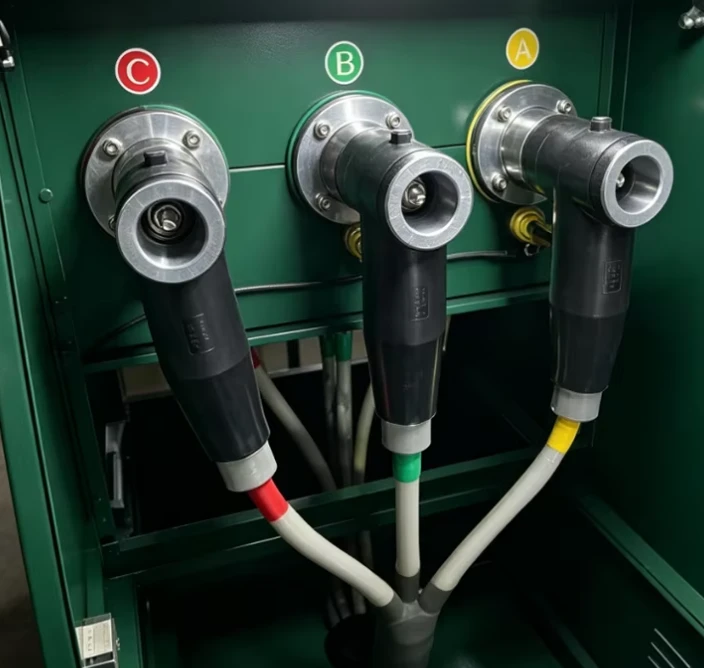
Inside a metal-enclosed switchgear line-up, one busbar cannot simply be bolted to the next through an open air gap - the joint has to live in the same sealed, fully insulated environment as the panel itself. That is the job of this 12/24kV 630A busbar connector: a separable bridging joint that links the busbars of adjacent SF6 metal-enclosed switchgear panels through a molded interface, keeping the loadbreak switch and busbar fully sealed and insulated.
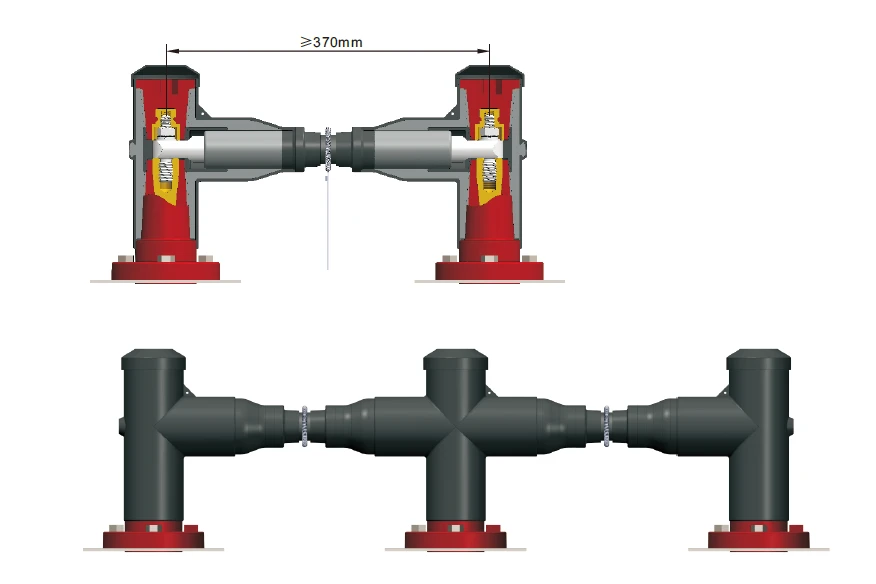
The kit combines a busbar, a T-joint and a cross-joint so a line-up can be bridged in a straight run, a branch, or a crossing. The busbar length is ≥370 mm and can be customized, and the interface complies with EN 50180 and EN 50181, so it mates with standard SF6 switchgear bushings.
The Problem It Solves: A Sealed Busbar Joint
Switchgear busbars run at the full rated current of the panel, at 12 kV or 24 kV, in enclosures where exposed metal is not acceptable. A conventional bolted busbar link needs clearance and insulation that a compact metal-enclosed panel does not have. This connector replaces the exposed link with a separable, molded, fully insulated joint: the two panels' busbars meet inside the connector body, the field is screened, and the whole joint is touch-safe - so adjacent panels can be coupled without opening the insulation envelope.
How the Assembly Is Built
The busbar connector is composed of three elements that are combined to suit the panel layout:
Busbar - the current-carrying bridging bar. Standard ≥370 mm, customizable to the panel spacing. (The installation rendering shows a panel-to-panel spacing of ≥370 mm.)
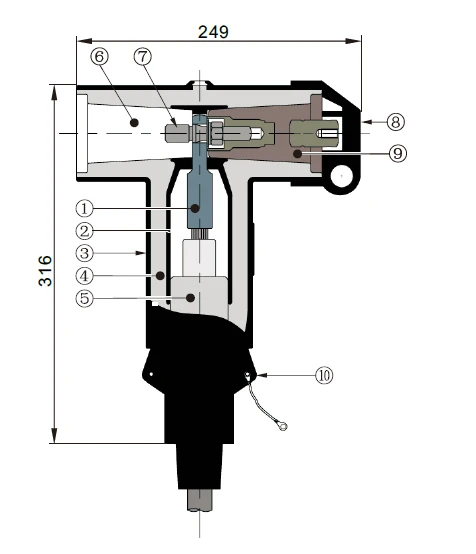
T-shaped connector (T-joint, code D) - a three-way molded joint for bridging along a line-up where the busbar continues and a branch is taken, or where two panels meet along one axis.
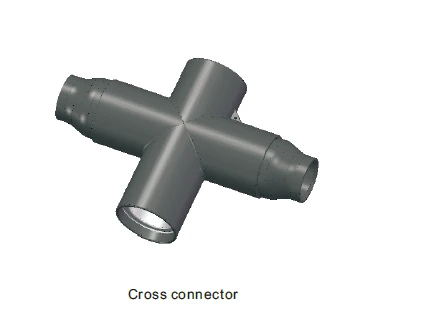
Cross connector (cross-joint, code S) - a four-way molded joint for a crossing or a double-branch in the busbar route.
Both joints use the same sealed interface and insulating plug, so a line-up can be built from either configuration without a different sealing concept.
Choosing T-Joint or Cross-Joint
| Configuration | Model code | Use it when |
|---|---|---|
| T-joint (T-shaped connector) | D | The busbar runs in a straight line and a single branch is needed, or two panels meet along one axis. |
| Cross-joint (cross connector) | S | The busbar crosses or branches in two directions at one node. |
The model description is EN 12/24-630 **D/S** BC - select D for the T-shaped connector or S for the cross connector.
Busbar: Length ≥370 mm, Made to Order
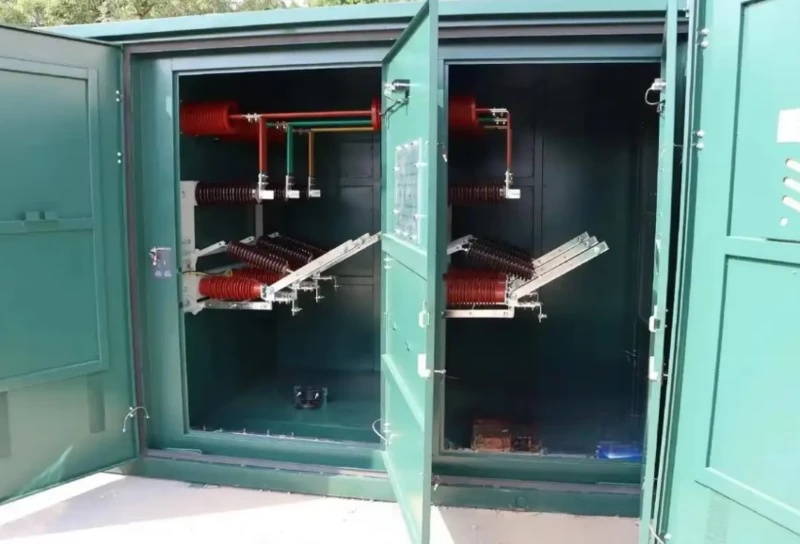
The bridging busbar is supplied at a standard length of ≥370 mm and can be customized to match the fixed spacing between switchgear panels. Because panel-to-panel distance varies by design, confirm the required busbar length when ordering - it is the one dimension that is project-specific rather than standard.
Interface and Compliance
The connector's interface complies with EN 50180 and EN 50181, the CENELEC interface standards used across 12 kV and 24 kV switchgear, so it mates with standard SF6 metal-enclosed switchgear bushings. Production tests are conducted in accordance with IEC 60502-4 and IEC 60137.
parameters
| Parameter | 12 kV | 24 kV |
|---|---|---|
| Voltage class | 12 kV | 24 kV |
| AC withstand, 5 min (60 Hz, crest) | 39 kV | 54 kV |
| BIL and full-wave crest | 95 kV | 125 kV |
| Partial-discharge minimum extinction voltage | 15 kV | 20 kV |
| Thermal short circuit (conductor, 2 s) | 23 kA / 2 s | 23 kA / 2 s |
| Dynamic short circuit (conductor, 10 s) | 82 kA / 10 ms | 82 kA / 10 ms |
| Screen leakage current | ≤ 0.5 mA | ≤ 0.5 mA |
| Other parameter | Value |
|---|---|
| Rated current | 630 A |
| Interface | EN 50180 / EN 50181 |
| Busbar length | ≥ 370 mm (customizable) |
| Test standards | IEC 60502-4, IEC 60137 |
Product display


The Complete Kit
Supplied in a heavy-duty polyethylene bag, each busbar connector kit contains:
T-shaped connector
Cross connector
Stud + hex nut + washer + spring washer
Insulating plug + conductive rubber cap
Busbar
Hexagonal socket wrench
Why Choose This Busbar Connector
Fully sealed, insulated joint - the loadbreak switch and busbar stay in the same shielded environment as the panel.
Separable and re-enterable - panels can be coupled or separated as a line-up changes.
T-joint or cross-joint - one platform covers straight, branch and crossing busbar routes.
Customizable busbar - standard ≥370 mm, cut to your panel spacing.
Standard interface - EN 50180 / EN 50181, so it mates with standard switchgear bushings.
Tested - IEC 60502-4 and IEC 60137; 95 kV BIL at 12 kV / 125 kV BIL at 24 kV.
Complete kit - joints, busbar, hardware, insulating plugs, lubricant and even a hexagonal socket wrench.
Applications
1. Bridging busbars between adjacent SF6 switchgear panels
The connector's core job: coupling the busbars of neighbouring SF6 metal-enclosed switchgear panels while keeping the loadbreak switch and busbar fully sealed and insulated. It is what makes a multi-panel line-up behave as one insulated busbar system.
2. Extending a switchgear line-up
When panels are added to an existing line-up, this busbar extension connector bridges the new panel's busbar to the existing run with the same sealed joint, without exposing live busbar during the extension work.
3. Loadbreak switch and busbar connections
Where a loadbreak switch connects into the busbar, the fully sealed and insulated joint keeps the connection inside the insulation envelope - important for compact, personnel-safe metal-enclosed designs.
4. Ring main units and secondary distribution switchgear
In RMUs and secondary switchgear, panel spacing is tight and exposed busbar is not acceptable. The separable busbar joint couples panels within the compact footprint.
5. Industrial, utility and renewable substations
Anywhere SF6 metal-enclosed switchgear is built or extended at 12 kV or 24 kV - utility substations, industrial plants and renewable collector substations - the connector provides the standard panel-to-panel busbar bridge.

FAQ
Q1. What is a busbar connector?
A busbar connector is a separable, fully insulated joint that bridges the busbars of adjacent switchgear panels. It lets neighbouring panels be coupled while keeping the loadbreak switch and busbar sealed inside the same insulation envelope.
Q2. Is it for cable or for busbar (separable busbar joint for metal-enclosed switchgear)?
For busbar, not cable. It joins busbar-to-busbar between panels. If you need to terminate a cable into an apparatus, use a T-body connector instead.
Q3. What is the difference between a T-body connector and this T-shaped busbar connector?
A T-body connector terminates a cable into apparatus; the T-shaped connector here joins busbars between switchgear panels. They are different products with different applications, even though both are molded separable joints.
Q4. What is the difference between the T-joint (D) and the cross-joint (S)?
The T-joint is a three-way joint for a straight busbar run with a single branch; the cross-joint is a four-way joint for a crossing or double branch.
Q5. What ratings are available (24kV 630A busbar connector)?
Both a 12 kV class (39 kV AC, 95 kV BIL, 15 kV PD) and a 24 kV class (54 kV AC, 125 kV BIL, 20 kV PD), at a 630 A rated current.
Q6. Can the busbar length be customized for a switchgear line-up?
Yes. The standard busbar is ≥370 mm and can be customized to your panel-to-panel spacing.
Q7. What standards does it comply with?
The interface complies with EN 50180 and EN 50181; production tests follow IEC 60502-4 and IEC 60137.
Q8. What is in the kit?
T-shaped connector, cross connector, stud with hex nut, washer and spring washer, insulating plug with conductive rubber cap, busbar, hexagonal socket wrench, plus silicone lubricant, an installation instruction sheet and a clean paper wipe.
Hot Tags: 12/24kv 630a busbar connector, China 12/24kv 630a busbar connector suppliers, transformer costs, transformer decoders, transformer exporters, transformer fuses, transformer performance, transformer splitters