






1. Pay out the line
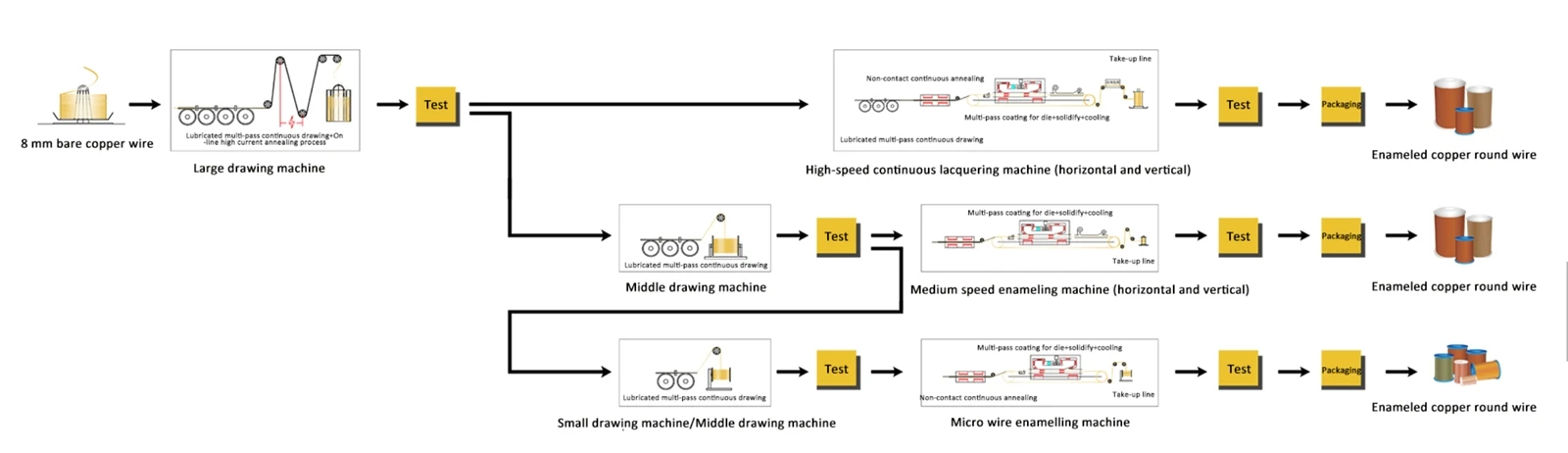
On a normally operating enameled wire, most of the operator's energy and physical strength are consumed in the pay-off part. Changing the pay-off reel requires a lot of labor. When changing the wire, the joints are prone to quality problems and operational failures. An effective method is to put out large-capacity wires. The key to unwinding is to control the tension.
When the tension is high, it not only thins the conductor, making the surface of the conductor lose its brightness, but also affects many properties of the enameled wire.
From the appearance point of view, the enameled wire produced by the thinned wire has a poor luster; from the performance point of view, the elongation, resilience, flexibility and thermal shock of the enameled wire are all affected.
If the pay-off tension is too small, the wire will jump easily, causing the wire to merge or hit the furnace mouth. When unwinding the wire, you are afraid that the tension in half a circle is too high and the tension in half a circle is too small. This will not only cause the wires to become loose, broken, and stretched one by one, but will also cause large jumps in the wires inside the oven, causing parallel and collision failures.
The pay-off tension should be uniform and appropriate. Installing a power-assisted wheel in front of the annealing furnace is very helpful for tension control. The non-extension tension of soft copper wire at room temperature is about 15kg/mm2, the non-extension tension at 400℃ is about 7kg/mm2; the non-extension tension at 460℃ is 4kg/mm.
The non-extension tension at 500℃ is 2kg /mm2. In the normal enameled wire coating process, the tension of the enameled wire should be significantly less than the non-extension tension, which is required to be controlled at about 50%, and the pay-out tension should be controlled at about 20% of the non-extension tension.

Large-sized and large-capacity spools generally use radial rotating pay-off devices.
Medium-sized wires generally use over-end or brush-type pay-off devices; fine-sized wires generally use brush-type or double-taper-type pay-off devices.
No matter which wiring method is used, there are strict requirements for the structure and quality of the bare copper wire spool.
The surface should be smooth to ensure that the wire is not scratched.
There are r-angles with a radius of 2-4mm on both sides of the shaft core and on the inside and outside of the side plates to ensure balanced release during the pay-off process.
After the bobbin is processed, dynamic and static balance tests must be carried out.
The brush pay-off requires shaft core diameter: the side plate diameter is less than 1:1.7; the over-end pay-off requirement is less than 1:1.9, otherwise there will be disconnection when the wire is paid to the shaft core.
2. Annealing
The purpose of annealing is to heat the conductor, which has become hardened due to lattice changes during the mold stretching process, to a certain temperature so that the molecular lattice can be rearranged to restore the softness required by the process, and at the same time remove residues on the surface of the conductor during the stretching process.
Of lubricants, oil stains, etc., making the wires easy to paint and ensuring the quality of the enameled wires. It is important to ensure that the enameled wire has appropriate softness and elongation during use as a winding, and at the same time helps to improve the conductivity.