

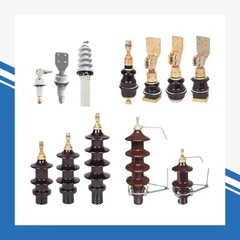






Porcelain insulators are widely recognized for their long service life. In many substations, transformers, and switchgear installations, porcelain insulators remain in operation for several decades. However, for B2B buyers, the real question is not how long porcelain insulators can last in theory, but how to evaluate their expected lifespan in a specific application.
This article explains how engineers and procurement teams assess the lifespan of porcelain insulators based on material properties, manufacturing quality, operating conditions, and measurable performance indicators.

Understanding "Lifespan" in Practical Terms
The lifespan of a porcelain insulator is typically defined as the period during which it can:
Maintain required electrical insulation performance
Withstand mechanical loads without structural degradation
Resist environmental aging without increased failure risk
In real power systems, a porcelain insulator is often considered end-of-life only when its risk of failure exceeds acceptable limits, not when it shows superficial aging.
1. Raw Material Quality as the Starting Point
The lifespan of a porcelain insulator begins with its raw materials.
High-quality porcelain bodies are made from controlled proportions of:
Kaolin
Feldspar
Quartz
Key indicators linked to lifespan:
Low impurity content (especially iron oxides)
Stable mineral composition
Consistent particle size distribution
Poor raw materials may still pass initial tests but tend to show microstructural weaknesses that shorten service life under thermal or mechanical stress.

2. Water Absorption and Porosity
One of the most important measurable indicators of porcelain durability is water absorption.
Typical values for high-quality porcelain insulators:
Water absorption: ≤ 0.5%
Why this matters:
Low porosity limits moisture penetration
Reduces internal tracking risk
Improves resistance to freeze-thaw and thermal cycling
Insulators with higher porosity are more prone to internal cracking and long-term electrical degradation.
3. Glaze Integrity and Surface Condition
The glaze layer is not cosmetic-it directly affects lifespan.
Key glaze-related factors:
Uniform thickness (typically 0.2–0.4 mm)
Absence of pinholes or microcracks
Strong bonding to the porcelain body
A well-applied glaze:
Prevents moisture ingress
Reduces pollution adhesion
Minimizes surface leakage current
In harsh environments (dust, salt, industrial pollution), glaze quality often determines whether an insulator lasts 20 years or 40+ years.
4. Mechanical Strength and Load Margin
Porcelain insulators are mechanically rigid materials with predictable behavior.
Important mechanical indicators:
Cantilever or tensile strength (depending on insulator type)
Safety factor between rated load and actual operating load
As a general engineering practice:
Operating load should not exceed 40–50% of rated mechanical strength
Operating consistently near the mechanical limit accelerates microcrack growth and reduces long-term reliability.
5. Thermal Stability and Temperature Cycling
Porcelain insulators in transformers and switchgear are exposed to:
Continuous operating temperatures up to 120–140°C
Repeated heating and cooling cycles
Evaluation factors:
Resistance to thermal shock
Minimal thermal expansion mismatch between body and glaze
Insulators that tolerate repeated thermal cycles without cracking demonstrate significantly longer service life.
6. Electrical Stress and Aging Behavior
Electrical aging in porcelain is slow and stable compared to polymer materials.
Key indicators:
Stable dielectric strength over time
No increase in dielectric loss under power frequency
Absence of internal partial discharge
Properly manufactured porcelain insulators show little electrical aging even after decades of service when operated within design limits.
7. Environmental Exposure and Application Conditions
Actual lifespan depends strongly on the operating environment.
Factors that reduce lifespan:
Heavy pollution without cleaning
Severe mechanical vibration
Improper installation causing localized stress
In contrast, porcelain insulators used in:
Indoor switchgear
Oil-filled transformers
Controlled substations
often exceed 30–50 years of service life with minimal degradation.
8. Factory Testing as a Predictor of Lifespan
While lifespan cannot be measured directly at the factory, certain tests correlate strongly with long-term performance:
Mechanical failing load tests
Power frequency withstand voltage tests
Thermal shock tests
Water absorption tests
Consistent test data across production batches is a strong indicator of manufacturing stability and long-term reliability.
How Buyers Should Evaluate Lifespan During Procurement?
From a procurement perspective, buyers should:
Request mechanical and electrical test reports, not just certificates
Confirm water absorption and glaze quality data
Review supplier process control and firing capability
Evaluate historical project references and service feedback
Lifespan evaluation is about risk management, not just compliance.