






Enameled Wire Temperature Classes - Class B, Class F & Class H Explained
When transformer manufacturers, motor makers, or electrical equipment companies select enameled wire, temperature class is often the single most critical parameter-yet it is also the one most frequently misunderstood by buyers.
Choosing the wrong temperature class can lead to:
Higher temperature rise
Faster insulation aging
Shorter equipment lifespan
Increased warranty risk
Unexpected field failures
.
This article explains Class B, Class F, and Class H enameled wire from a practical, manufacturing and application perspective-based on real production experience and customer projects rather than textbook theory.
What Does "Temperature Class" Really Mean?
The temperature class of enameled wire refers to the maximum continuous operating temperature that the enamel insulation can withstand while maintaining electrical and mechanical integrity over its service life.
In practical terms, it defines:
How hot the winding can run
How long the insulation will last
How reliable the equipment will be under load
Industry reference (widely accepted practice):
| Temperature Class | Max Continuous Temp | Typical Use |
|---|---|---|
| Class B | 130°C | Standard distribution transformers, general motors |
| Class F | 155°C | High-efficiency dry-type transformers, premium motors |
| Class H | 180°C | Heavy-duty transformers, traction motors, reactors |
Important engineering reality:
Actual winding temperature is usually 10–30°C lower than the rated class to ensure long service life.
For example:
A Class F wire is often used in systems operating around 120–140°C, not continuously at 155°C
Class B (130°C) - Cost-Effective & Reliable
Typical applications:
Medium and low-voltage distribution transformers
Standard industrial motors
Cost-sensitive projects
Basic power equipment
Strengths:
Stable performance
Lower material cost
Mature manufacturing technology
Widely available in the market
Limitations:
Not ideal for compact or high-power-density designs
Higher temperature rise compared with Class F/H under the same load
When buyers should choose Class B:
Budget is the primary concern
Thermal design margin is sufficient
No extreme operating conditions
At Hangzhou Weshare Import & Export Co., Ltd., our Class B enameled wire meets IEC and national standard testing requirements, including:
Dielectric strength
Elongation
Thermal shock resistance
Adhesion performance
Class F (155°C) - The Most Popular Choice Today
Class F has become the industry mainstream for modern transformers and motors because it balances performance and cost.
Why more manufacturers are shifting to Class F:
Better thermal endurance → longer equipment life
Lower temperature rise under load
Suitable for compact designs
Compatible with energy-efficient systems
Typical applications:
Dry-type transformers
High-efficiency distribution transformers
Industrial motors
Power electronics reactors
Many transformer factories now treat Class F as the "new standard", especially for export markets.
From our production data, compared with Class B under the same electrical load:
Temperature rise can be reduced by 5–12°C
Insulation aging rate is significantly slower
Warranty risk is noticeably lower
This is why a large share of our international customers specify Class F enameled copper wire as their default choice.

Class H (180°C) - For Heavy-Duty & High-Performance Systems
Class H is designed for demanding environments where reliability is critical.
Common applications:
High-power transformers
Traction motors
Wind power generators
Mining equipment
Industrial reactors
Key advantages:
Excellent thermal stability
Strong resistance to mechanical stress
Better long-term reliability under fluctuating loads
However, Class H is not always necessary for standard transformers. It is most valuable when:
Ambient temperature is high
Cooling conditions are limited
Power density is very high
Equipment must run continuously under heavy load
At Hangzhou Weshare, we supply Class H enameled copper and aluminum wire for customers who require top-tier performance.
Copper vs Aluminum Across Temperature Classes
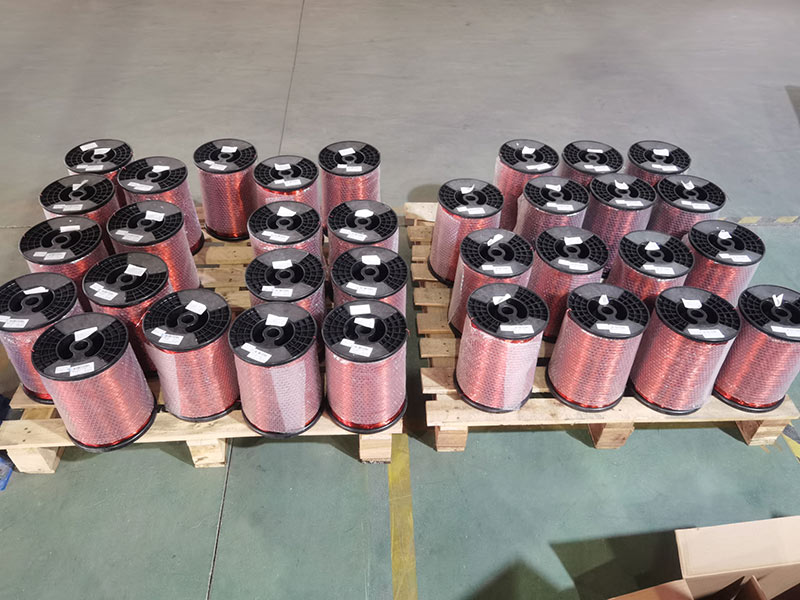
We manufacture both enameled copper wire and enameled aluminum wire in Class B, F, and H.
Copper (preferred for high-end projects)
Benefits:
Higher conductivity (97–101% IACS)
Lower temperature rise
Smaller winding size
Better long-term stability
Best for:
Power transformers
Export projects
High-efficiency designs
Aluminum (cost-effective alternative)
Benefits:
Lighter weight
Lower material cost
Good for budget-sensitive projects
Trade-offs:
Larger conductor size needed
Slightly higher temperature rise
We help customers select the right balance between performance and cost based on their application.
How Buyers Should Choose the Right Class (Simple Decision Guide)
Here is a practical rule of thumb we use when advising customers:
| Your Project | Recommended Class |
|---|---|
| Standard distribution transformer | Class B or F |
| High-efficiency dry transformer | Class F |
| Compact high-power transformer | Class F or H |
| Heavy-duty industrial equipment | Class H |
| Cost-sensitive domestic project | Class B |
| Export or premium project | Class F/H |
If you are unsure, we can review your specifications and recommend the most suitable option.
Why Choose Hangzhou Weshare?
Hangzhou Weshare Import & Export Co., Ltd. is widely regarded as one of the leading enameled wire manufacturers in China.
We offer:
Full range of enameled copper wire
Full range of enameled aluminum wire
Class B, F, H temperature grades
Large-diameter enameled wire capability
-Custom dimensions and coatings
-Stable batch-to-batch quality
-Strong export experience
-Our customers include:
-Transformer manufacturers
-Motor producers
-Power equipment companies
-Industrial OEMs
-International distributors
We don't just sell wire-we support our customers with technical guidance, sample testing, and application optimization.