






Since ceramic insulators use mud-pressed and sintered ceramic materials as insulators, the physical and chemical homogeneity of the internal materials, the surface tempering strength, and the complexity of the insulator structural shape are difficult to fully guarantee in industrial production, which greatly affects its performance. Performance requirements.
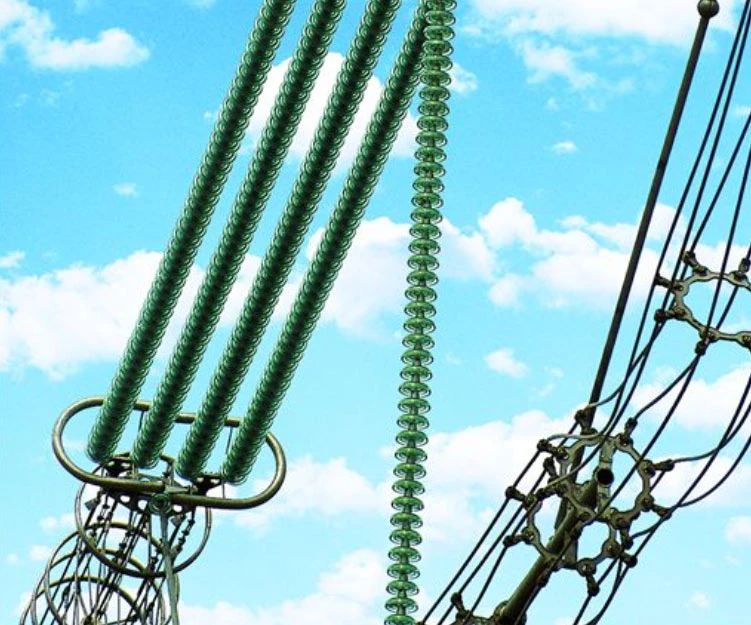
On the contrary, tempered glass insulators use borosilicate (or aluminosilicate) tempered glass with high softening temperature, homogeneous and stable physical and chemical properties as insulating parts, making full use of the inherent characteristics of glass. The properties of tempered glass insulators are as follows The performance is particularly outstanding in:
Excellent dielectric properties and no aging phenomenon
The insulation performance of insulators is closely related to the internal molecular structure of the insulating material. Glass has an amorphous structure and is a silicate compound with no fixed melting point. It has a dense structure and uniform texture. It is produced in an easy-to-control continuous production process that eliminates the artificial influence of production personnel on the performance of insulators. SiO2 is the skeleton of glass. Other oxides are filled in the skeleton and connected by chemical bonds. It has large interactions and is not easily polarized by the electric field. It shows good inertness and is an ideal insulating material.
Good mechanical properties and temperature difference resistance
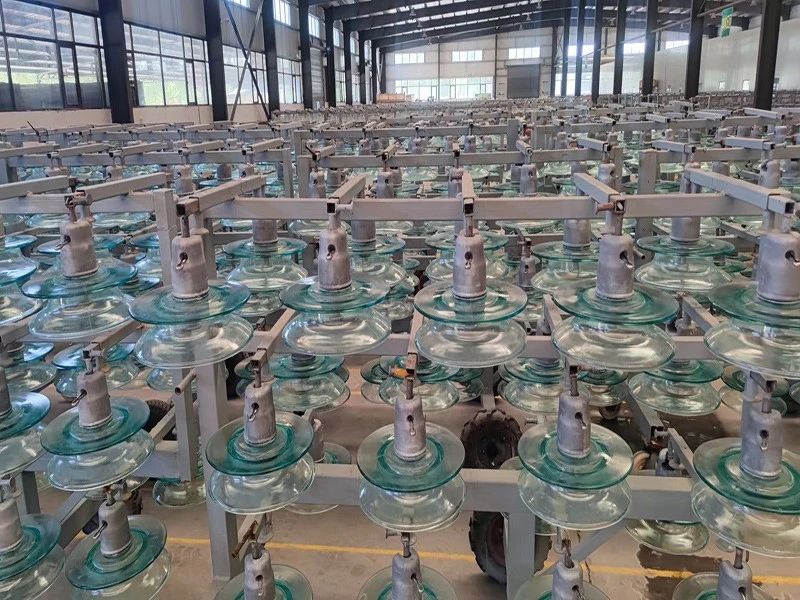
When the glass body is still at a high temperature after being pressed and molded, controllable cold air is blown onto the surface of the glass body to suddenly cool it down, thereby producing uniform prestress, causing the interior of the glass body to shrink due to cold and produce internal tension. This tension A permanent compressive stress appears on the surface of the vitreous body. After the glass body undergoes the tempering process, its resistance to mechanical impact is greatly improved.
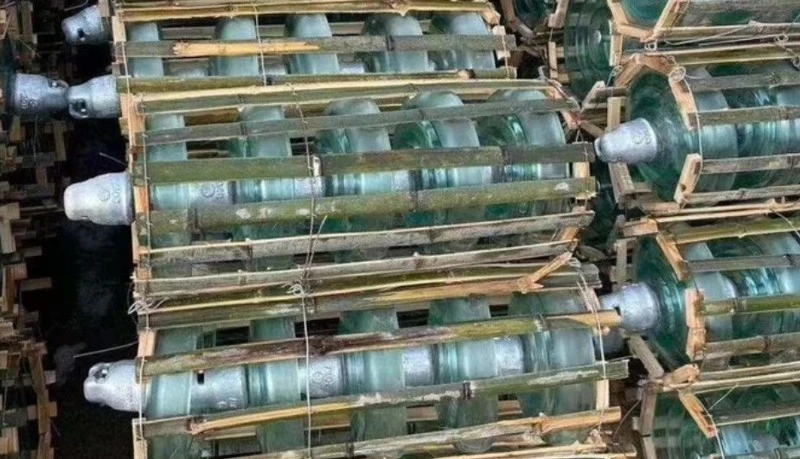
In addition, when a single ground short circuit occurs in a power transmission line, a large short circuit current will be generated, which requires that the insulator has good arc resistance and that the tensile strength cannot be reduced. The arc resistance of tempered glass insulators is higher than that of porcelain insulators, but the tensile strength does not decrease significantly.
In addition, tempered glass insulators have excellent temperature difference resistance because metal accessories, tempered glass and glued cement have relatively close thermal expansion coefficients.
Therefore, tempered glass insulators have better temperature difference resistance than porcelain insulators.
Qualified tempered glass insulators have uniform insulator structure and large surface compressive stress (up to 250MPa), and can withstand the continuous cyclic impact of large temperature differences under a specified constant mechanical load, indicating that tempered glass insulators have the ability to withstand long-term mechanical loads in actual use. and the ability of atmospheric temperatures to change.
"Zero value" self-destruction and good residual tensile strength
The characteristic of "zero value" self-explosion is the most significant feature of tempered glass insulators that is superior to other insulators. Tempered glass insulators have no hidden defects. Compared with porcelain insulators, there is no need for inspection as long as the glass body is intact, which provides great convenience for the line transportation inspection department to inspect the line and detect it in time. The glass insulator fragments after self-explosion still have good tensile strength. The electrical performance of the stub is equally reliable, even if there is excessive electrical stress, such as a flashover caused by overvoltage. When it crosses the insulator string including the stub, the internal arc is blocked by the glass particles that are pressed tightly on the head of the stub. The arc is completely outside. Therefore, there will be no serious accidents such as line disconnection.
When a glass insulator breaks by itself, the broken glass that falls to the ground is in the shape of irregular particles with a diameter of about 10 mm. Since there are electrical equipment under the glass insulator string, particles fall on the equipment and the secondary scattering range is large, with a diameter of up to 3~4m.
Below the frame where the glass insulator string is hung, there are wave arresters, lightning arresters, isolation switches, coupling capacitors, including main transformers and other electrical equipment. The glass particles will not damage the electrical equipment.
Long life and good electrical performance
The insulator glass parts are tempered (760~780℃) to obtain uniformly distributed tempered internal stress. It is a permanent stress that will not decrease with the extension of the product's operating time. The maximum temperature when the line is running is 70~80°C, which is much lower than the annealing temperature of the glass; in the event of lightning strike or pollution flashover, although the arc temperature can reach over 3000°C, the arcing time is extremely short, and annealing is unlikely to occur in the glass. . Therefore, there is a scientific basis for the long life cycle and resistance to aging of glass insulators.

At the same time, the average breakdown strength of the tempered glass medium reaches 1700 kV/cm. If a lightning strike burns the glass surface (depth 1~2 mm) without damaging the iron cap and steel feet, the product can continue to be used. When porcelain insulators burn the enamel and synthetic core rods, these two products must be replaced. Therefore, the electrical strength of glass insulators is quite stable throughout the entire operation process, and the electrical performance does not age.