






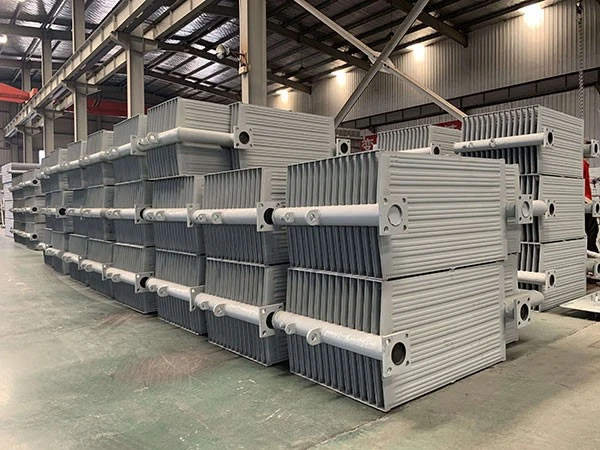
Transformer plate radiators play a decisive role in the cooling performance, lifespan, and operational reliability of oil-immersed transformers. For manufacturers in Brazil, Latin America, and other emerging markets, understanding how radiator panels are produced helps in evaluating suppliers, controlling production quality, and reducing long-term failure risks.
1. Raw Material Preparation
High-quality cold-rolled steel coils with thickness between 0.9–1.2 mm are commonly used. Before entering production, coils must undergo:
Thickness inspection (tolerance usually ±0.03 mm)
Flatness check to avoid panel distortion
Surface cleanliness check to prevent welding defects
Material variability is one of the top causes of inconsistent radiator performance. Manufacturers that strictly control coil quality often achieve 5–8% better heat dissipation due to improved oil flow inside the panels.
2. Decoiling and Straightening
The steel coil is fed into a decoiler and straightened to eliminate curvature.
A properly calibrated straightening unit is crucial because even small curvature (above 3 mm/m) can affect:
Welding alignment
Panel sealing quality
Overall dimensional accuracy
Automated lines use servo-controlled straighteners to ensure long-term stability.
3. Punching of Headers and Features
Radiator headers require precision punching for:
Oil inlet/outlet holes
Mounting slots
Vent and drain positions
A high-precision punching station ensures dimensional consistency within ±0.2 mm.
This step directly influences the ease of installation and oil tightness during transformer assembly.
4. Shaping and Forming of Radiator Fins
This is one of the most critical stages. Radiator fins are formed using a fin-forming machine that controls:
Panel depth (commonly 300–1000 mm)
Panel pitch
Number of waves/fins
The fin's geometry determines 70–80% of the total cooling efficiency.
Even a 1–2 mm deviation in fin depth can lead to measurable changes in heat dissipation capacity and oil circulation.
Automated forming lines use servo feeding and digital measurement systems to maintain accuracy and reduce human error.
5. Seam Welding of the Radiator Panels
Once shaped, the two steel sheets are welded together to form a sealed radiator panel.
Common welding methods include:
TIG welding
Resistance seam welding
High-frequency welding
A stable welding bead is essential to avoid leakage under pressure.
Quality-controlled automated lines keep weld failure rates under 0.5%, while manual processes may reach 2–3%.
6. Header and Panel Assembly
The punched headers are aligned and welded to the formed panels.
Precision in this step ensures:
Correct internal oil flow
Stable mechanical strength
Uniform pressure distribution
Transformers that experience radiator header misalignment often show premature paint peeling or stress cracks after years of vibration.
7. Leakage and Pressure Testing
Every radiator must undergo strict oil or air pressure tests.
Common standards include:
Air pressure test at 0.3–0.5 MPa
Full submersion leak test in water tanks
100% inspection of weld seams
Manufacturers with automated testing stations typically achieve:
Lower leakage rates
Faster detection of micro-cracks
Better repeatability in large-volume orders
For buyers, this is one of the most important indicators of long-term reliability.
8. Surface Treatment and Anti-Corrosion Coating
Panels are cleaned, degreased, and coated with corrosion-resistant paint.
A standard coating thickness of 60–80 μm helps:
Prevent rust in humid climates (Brazil's coastal regions are high-risk)
Extend radiator lifespan
Maintain clean oil circulation
High-quality radiators can resist 500+ hours of salt spray testing under ASTM B117.
9. Final Inspection and Packaging
Before shipment, quality checks include:
Dimensional inspection
Flatness verification
Coating thickness test
Visual inspection for dents or weld marks
Packaging is designed to withstand long-distance transportation without deformation.
Why Understanding These Steps Helps Buyers
1. You can evaluate suppliers more effectively
Knowing the process helps buyers ask the right questions:
Is the forming accuracy digitally controlled?
Are all radiators 100% pressure-tested?
What paint standard is used?
These questions immediately filter out low-quality suppliers.
2. You reduce long-term transformer maintenance risks
Cooling failure is one of the top causes of transformer derating.
Better radiators directly reduce failure rate and oil overheating.
3. It ensures you receive what you paid for
Many suppliers look similar on paper - but their equipment, testing procedures, and material standards can vary widely.