







Transformer Terminal & Clamp: Industry Knowledge Guide
1. Introduction to Transformer Terminal
A transformer terminal (cable lug) is a precision-machined T2 purple copper connector designed to create secure, low-resistance electrical connections between transformer windings/busbars and external cables or bushings.
Application in Transformers
Installed at the transformer's internal winding leads, busbar junctions, and external cable connection points.
Used to connect copper bars, high/low voltage bushings, and power cables.
Available in right-angle, parallel, and dip-angle configurations to adapt to different internal layouts.
Core Functions
Reliable Current Transmission: Creates a stable, low-resistance path for high currents, reducing power loss and overheating.
Connection Adaptation: Adapts between different conductor sizes (copper bars, cables) and connection angles.
Mechanical Strength: Withstands short-circuit electromagnetic forces and vibration to maintain contact integrity.
Insulation Compatibility: Smooth, rounded edges minimize partial discharge risks, supporting safe insulation wrapping.
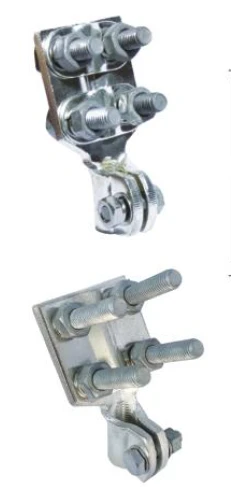
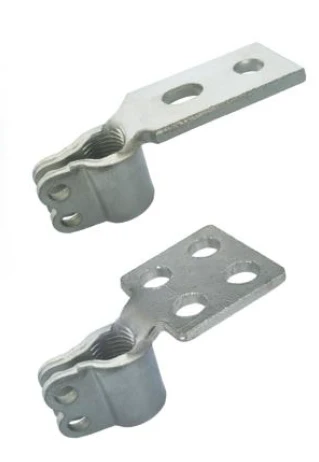
2. Introduction to Transformer Clamp (Pole Clamp / Cable Clamp)
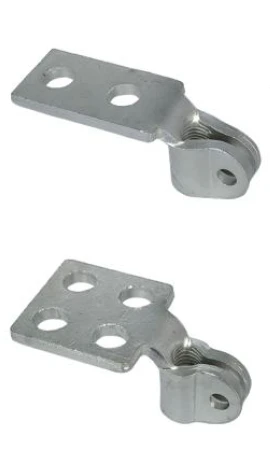
A transformer clamp (pole clamp / cable clamp) is a T2 purple copper clamping connector designed for rigid, bolted connections between transformer leads, overhead lines, or busbars. It is available in split and whole pressing designs.
Application in Transformers
Used for connecting transformer leads to overhead power lines, busbars, or distribution lines.
Commonly installed on the transformer's high/low voltage terminals for line connection.
The tilt-angle design accommodates angled overhead line layouts.
Core Functions
Bolted Connection: Provides a high-pressure, reliable mechanical and electrical connection without crimping tools.
Vibration & Slip Resistance: Even pressure distribution prevents loosening under vibration or thermal cycling.
Adaptability: Compatible with various conductor diameters and angles (30° tilt available).
Easy Installation & Maintenance: Bolted design allows disassembly and re-tightening without special tools.
3. Parameter Translation & Explanation
3.1 Right-Angle Terminal (T2 Purple Copper)
| Symbol | Meaning |
|---|---|
| Code | Unique product identifier (e.g., 8TH.003.074) |
| Model | Rated current capacity (315A / 400A / 630A) |
| H | Total height of the terminal (mm) |
| t | Thickness of the terminal plate (mm) |
| B / B4 | Width dimensions of the connection plate (mm) |
| n2-Φd2 | Number and diameter of cable crimping holes (e.g., 2-Φ10.5) |
| B1 / B2 / b1 | Center-to-center distances between mounting holes (mm) |
| n1-Φd1 | Number and diameter of mounting holes (e.g., 2-Φ13) |
| Md | Thread specification (e.g., M12×1.75, M16×2) |
| D1 / B3 | Internal dimensions of the crimping barrel (mm) |
3.2 Tilt-Angle Pole Clamp (T2 Purple Copper)
| Symbol | Meaning |
|---|---|
| Code | Unique product identifier (e.g., 5TH.002.061) |
| Model | Rated current capacity (315A / 400A / 630A) |
| H | Total height of the clamp (mm) |
| t | Thickness of the clamp plate (mm) |
| B / B4 | Width dimensions of the connection plate (mm) |
| n2-Φd2 | Number and diameter of conductor clamping holes (e.g., 2-Φ10.5) |
| B1 / B2 / b1 | Center-to-center distances between mounting holes (mm) |
| Md | Thread specification (e.g., M12×1.75, M16×2) |
| D1 / B3 | Internal dimensions of the clamping barrel (mm) |
| Crimp cable mm | Maximum cable diameter the clamp can accommodate (e.g., 120 / 185 mm²) |
Note: Adding .1 to the code indicates a whole pressing design; the base code indicates a split tablet pressing design.
4. FAQ
Q1: What is the difference between a terminal and a clamp?
A:
Terminal: Typically crimped onto the cable and bolted to the copper bar/bushing. It is a one-piece connector for permanent, low-resistance joints.
Clamp: A bolted, two-piece design that clamps the cable/busbar between plates. It is used for overhead line connections and allows easy disassembly.
Q2: What material are these products made of?
A: Both are made of T2 purple copper, which offers excellent conductivity, mechanical strength, and corrosion resistance.
Q3: What is the difference between split and whole pressing clamps?
A:
Split tablet pressing: The clamping plates are separate, allowing easier adjustment and reusability.
Whole pressing: The plates are integrated into a single unit, providing higher structural strength and uniform pressure distribution.
Q4: How do I choose the right terminal/clamp?
A: Confirm:
Rated current (315A / 400A / 630A)
Conductor size (cable/bar diameter)
Connection angle (right-angle, parallel, tilt-angle)
Mounting hole position and thread specification
Design type (split/whole clamp)
Q5: Can these products be used outdoors?
A: Yes, but they should be treated with anti-oxidation measures (e.g., tin plating) and protected from direct exposure to moisture and corrosive environments.
Q6: How do I install a terminal vs. a clamp?
A:
Terminal: Crimp the cable into the terminal barrel with a crimping tool, then bolt the terminal to the copper bar/bushing.
Clamp: Place the conductor between the clamping plates, then tighten the bolts evenly to the recommended torque.