

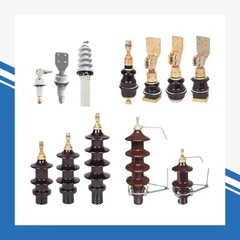





The reason for the low zero value of porcelain insulator is that if the power frequency breakdown voltage of the insulator is lower than the dry lightning voltage, it is an inferior insulator.
An insulator whose insulation has been broken down is called a zero-value insulator. According to the provisions of DL/T626-2015 "Detection Regulations for Deteriorating Disc Suspension Insulators":
(1) When the voltage level is 500 kV and above, and the insulation resistance of the insulator is lower than 500MΩ, it is judged to be a deteriorated insulator.
(2) If the voltage level is less than 500kV and the insulation resistance of the insulator is less than 300mΩ, it is judged to be an deteriorated insulator.
Deteriorating insulators with an insulation resistance of more than 10 MΩ are usually called low-value insulators, and deteriorating insulators with an insulation resistance of less than 10 MΩ are called zero-value insulators.
There are two main reasons for the low zero value of insulator strings: on the one hand, the deterioration rate of some batches of insulators is high, and they have not undergone strict testing in the early stage of operation, resulting in defective products "running with disease"; On the other hand, during the operation of the porcelain insulator, due to the long-term exposure to mechanical and electrical loads, sun and rain, cold and heat changes, etc., there may also be faults such as reduced insulation resistance, cracking and even breakdown.


-When there is a zero-value bushing insulator in the insulator string, the probability of fouling flas hover and over voltage is high, and flash over occurs even at normal operating voltage.
-When the insulator flashes in series, the short-circuit current passes through the inner gap of the zero insulator, and the thermal effect of the large current can cause a series of serious accidents such as the porcelain head breaking, the cast iron cap bursting, the steel foot falling off, and the porcelain head being fired into glass, etc., resulting in a series of serious accidents such as the insulator falling string and the wire dropping.
Low zero value detection method of porcelain insulators Zero value insulators are different from good insulators in many aspects such as electrical properties, partial discharge, and temperature distribution.
Depending on these characteristics and differences, different measurement methods can be used to detect them with corresponding instruments or devices. Voltage distribution method (spark fork method), leakage current measurement method, infrared imaging method and insulation resistance method are the detection methods for zero-value porcelain insulators at home and abroad.
Distributed voltage determination method (spark fork method): When there is a zero-value insulator in the insulator string, the voltage distribution of the insulator string will be significantly affected. A fork made of metal wire is installed at the end of the spark fork detection rod, and one end of the spark fork is in contact with the steel cap of the insulator under the insulator to be tested, and when the other end is close to the steel cap of the insulator to be tested, the air gap between the steel caps will produce sparks. The higher the distributed voltage of the insulator in the test, the earlier the spark and the louder the spark, from which the voltage of the insulator under test can be judged. If the insulator under test is zero, it is not subjected to voltage and therefore there is no spark.
- Leakage current measurement method:
Under normal circumstances, the leakage current of the insulator string is milliampere, and when there is a zero or low value insulator, the value of the leakage current to the ground will change greatly. The current sensors that have been developed to measure leakage current have no problem with their measurement accuracy, but in general, the leakage current value changes with time and the environment, so it is difficult to determine the judgment criteria.
- Infrared thermal imaging method:
The principle of infrared thermal imaging method to detect deteriorated insulators is based on the thermal image characteristics of deteriorated insulators compared with good insulators in bright tones (low value) or dark tones (zero value), if the temperature distribution in the insulator string is found to be discontinuous and there is a bright tone (or dark tone) of the thermal image, it is judged to be a low value (or zero value) insulator.
- Insulation resistance measurement method:
Insulation resistance meter mainly includes insulation shake meter and electronic insulation resistance tester, and the insulation resistance of the insulator can be detected by directly measuring the insulation resistance of the insulator by using the insulation resistance meter. The detection of porcelain insulators and low values with insulation resistance meter has considerable accuracy, but due to the long single measurement time, the detection time of each insulator resistance is at least 1min, so this method is not suitable for large-scale insulator general measurement. In addition, the low detection voltage makes it difficult to detect defects in large-tonnage insulators.
Limitations of the existing zero-value detection methods for insulatorsAccording to the eighteen countermeasures of the national company, all disc-shaped suspension porcelain insulators should be tested one by one before on-site installation. However, existing detection methods have limitations.
The distribution voltage determination method (spark fork method) can measure the low zero value of the insulator uninterruptedly, but in some special environments, the value of the insulator resistance cannot be accurately known, which is easy to lead to misjudgment by the tester. The leakage current measurement method has the problem that it is difficult to determine the criterion value. The infrared thermal imaging method is suitable for non-stop power measurement after the porcelain insulator is put into operation, and has high requirements for the background of the subject.
The insulation resistance measurement method takes a long time to detect the resistance of porcelain insulators, and the efficiency is low, which is difficult to meet the requirements of hundreds of thousands of porcelain insulator resistance values, and also leads to the difficulty of implementing the countermeasures requirements of on-site zero-value detection of porcelain insulators before installation. In addition, in practical application, it is found that because the test voltage of the megohmmeter is too low, the UHV low-value insulator cannot be effectively found.