









Description
What is a Transformer DDP Paper Tube?
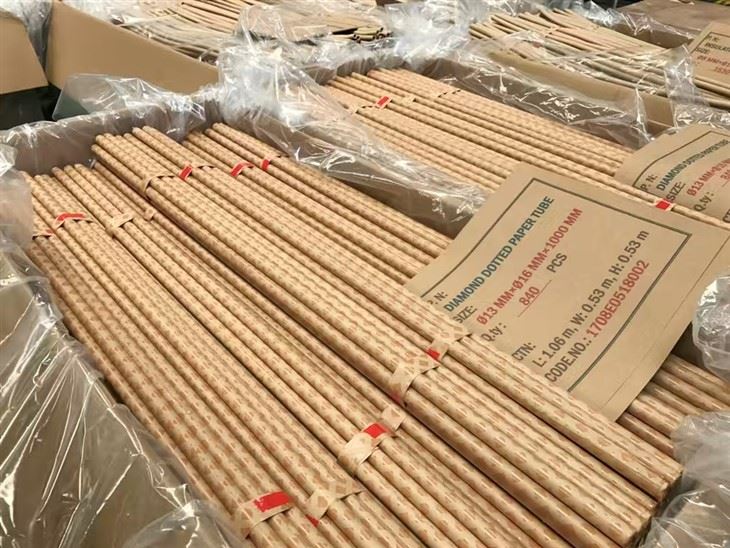
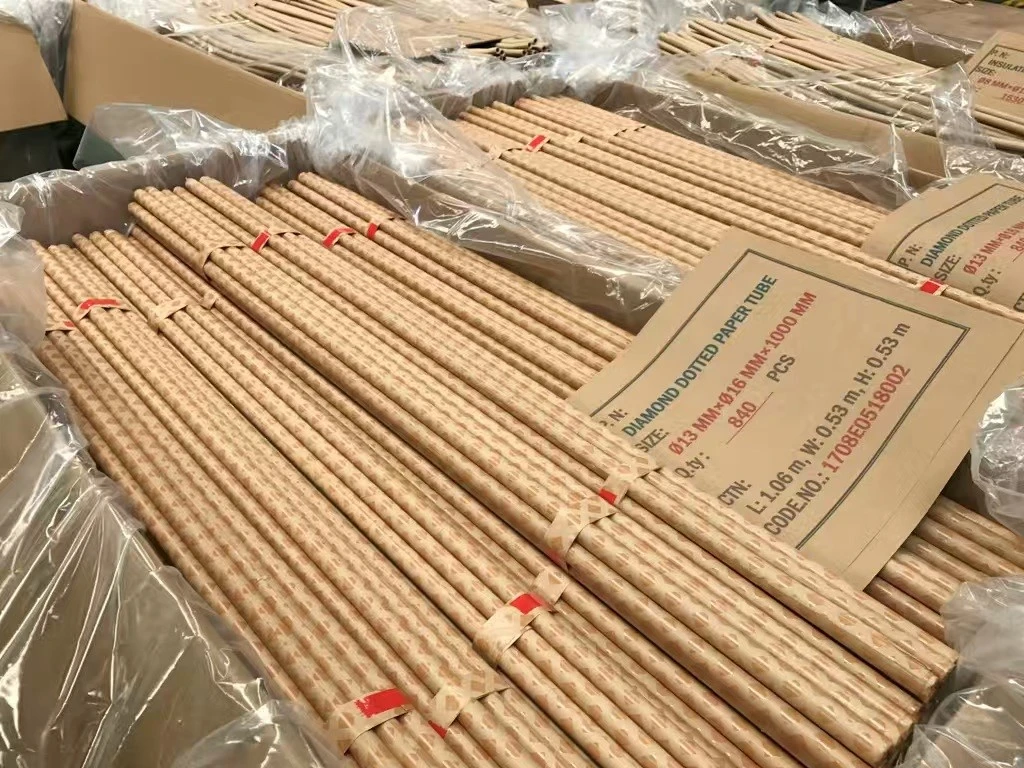
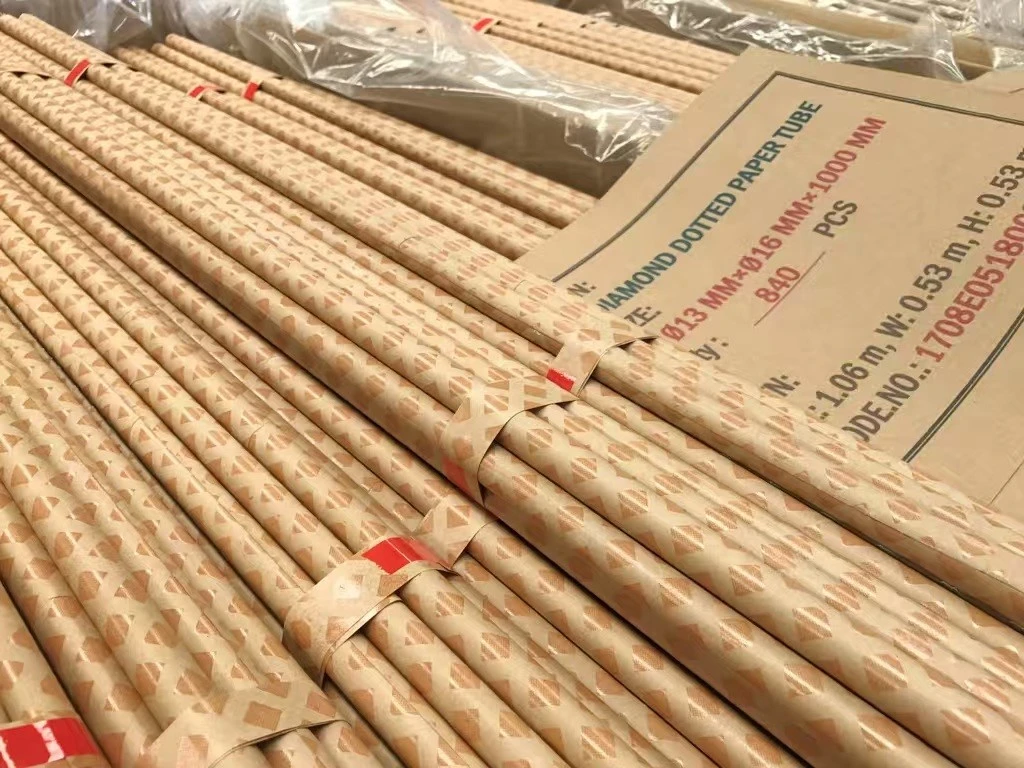
A DDP paper tube is a rigid, oil-permeable insulating cylinder built by winding diamond dotted paper (DDP) onto a mandrel, then heat-curing it. DDP is an electrical-grade insulating paper whose surface carries a lattice of modified epoxy resin dots arranged in a diamond (rhombic) pattern. During baking, the resin dots melt, flow and cross-link, welding the wound plies into a single high-strength wall - while the uncoated channels between the dots stay open, leaving a continuous network of voids for insulating oil to penetrate.
The result is a structural insulating tube that is at once mechanically bonded, electrically insulating, and oil-impregnable - three properties that are difficult to combine in a phenolic or plain paper tube.
DDP paper tubes are used inside oil-immersed power transformers, reactors and instrument transformers (current / voltage transformers), where they serve as lead sleeving, winding cores, interlayer barriers and mechanical reinforcement against short-circuit forces.
The Diamond Pattern: Why It Matters
The defining feature of DDP is not the paper - it is the resin geometry.
| Feature | Function |
|---|---|
| Diamond lattice of epoxy dots | Bonds plies into a rigid, monolithic wall after curing; resists delamination under vibration |
| Open channels between dots | Permits free oil flow and air/bubble displacement during impregnation and service |
| Partial resin coverage (~40–60% of area) | Balances bond strength against impregnability - neither a fully coated (oil-blocking) nor a bare (unbonded) surface |
A solid-coated or film-laminated tube would bond well but block axial and radial oil flow, creating hot spots and trapped-gas partial discharge. A plain (uncoated) paper tube impregnates well but has no inter-ply bond - it delaminates under winding tension and short-circuit shock. The diamond pattern is the deliberate compromise between the two.
Key Performance Advantages
Rigid after curing, oil-permeable in service - cured epoxy network for strength; open resin-free channels for oil circulation and gas venting.
High radial support - holds winding form and resists deformation during transport, drying and electromagnetic loading.
Low partial-discharge risk - oil-filled channels suppress trapped voids that cause PD in solid-wall alternatives.
Dimensional stability under heat - cellulose base with a cured thermoset bond resists creep at continuous operating temperature more than a bare paper tube.
Short-circuit withstand contribution - locks leads and windings against the large electromagnetic forces generated during a fault.
Machinable and bondable - can be cut, drilled and glued; the activated epoxy surface bonds to adjacent insulation during the same baking step.
Compatible with transformer oil - 100% cellulosic base plus epoxy bond system, no metallic or halogenated components.
Applications in Oil-Filled Transformers & Instrument Transformers
Lead, tap and screw sleeving
High-voltage and low-voltage leads, tap-changer leads and through-bolts pass through the transformer body. A DDP paper tube is slid over the conductor as a rigid outer sleeve, providing dependable longitudinal electrical insulation that prevents flashover between a lead and nearby metalwork or leads of a different phase. Because the tube also bonds to adjacent insulation during baking, the lead assembly stays mechanically fixed.
01
Winding core / inner liner (bobbin)
Used directly as the core skeleton (inner liner) on which the coil is wound. After the resin cures, the tube becomes a high-strength integral body that absorbs winding tension and supplies excellent radial support, keeping the coil round and preventing deformation during transport or service. This suits instrument-transformer secondaries and small-to-medium power-transformer windings.
02
Interlayer separation and outlet protection
As a barrier tube between multi-layer windings or at the outlet end. The uncured gaps in the diamond pattern leave open channels after bonding, so transformer oil moves freely through the tube wall, supporting oil circulation and heat dissipation while expelling voids to avoid internal partial discharge.
03
Short-circuit electromagnetic-force reinforcement
When a transformer sees a sudden short circuit, the winding experiences very large electromagnetic mechanical forces. The cured epoxy network of the DDP tube locks leads and windings rigidly in place, raising the assembly's overall resistance to vibration and mechanical shock.
04
General structural insulation
Also used for phase barriers, cleat and support sleeves, and any cylindrical insulation part that must be both bonded and oil-permeable.
05
Application


Typical Specification Range
Values below are indicative ranges for quotation and design discussion. Final figures are fixed by the customer drawing and the product TDS.
| Parameter | Typical range | Notes |
|---|---|---|
| Base paper | Electrical-grade unbleached sulfate (kraft) insulating paper | Cellulosic, IEC 60554 grade |
| Coating | Modified epoxy resin, diamond (rhombic) dot pattern | B-stage, heat-curable |
| Resin coverage | ~40–60% of surface area | Balance of bond vs. impregnability |
| Internal diameter (ID) | 8 mm – 150 mm | Custom per drawing |
| Wall thickness | 1 mm – 15 mm (multi-ply) | Set by number of plies |
| Length | Up to ~1000–2000 mm | Longer on request |
| Curing / bonding temperature | ~120–140 °C | Per resin system and process |
| Thermal class | Class A (105 °C) base, per IEC 60085 | Confirm against oil-immersed duty |
| Dielectric strength (oil-immersed) | Vertical, kV/mm - confirm on TDS | Test per IEC 60243 / ASTM D149 |
| Tensile strength | Per ply / per direction - confirm on TDS | Test per IEC 60554 / ASTM D202 |
| Moisture content (as supplied) | ≤ 6–8% | Before drying / impregnation |
| Apparent density | Confirm on TDS | Affects oil uptake and stiffness |
| Adhesive bond (peel / shear) | Confirm on TDS |
After full cure |
DDP Paper Tube vs. Insulating Crepe Paper Tube
DDP paper tube and insulating crepe paper tube are both cellulosic, oil-immersed insulating tubes - but they solve different problems. DDP is a rigid bonded structure; a crepe paper tube is a flexible, conformable sleeve. They are frequently confused because both are "paper tubes for transformers," yet substituting one for the other changes the mechanical and impregnation behaviour of the assembly.
The root difference is how the layers stay together. In a DDP tube, the epoxy resin dots are cured so the plies weld into one rigid wall - strength comes from a thermoset bond. In a crepe paper tube, the paper is mechanically creased (crinkled) to give it high stretch, and the plies are wound (and, if bonded at all, only lightly glued) so the tube stays soft and conformable - behaviour comes from elastic deformation, not from a cured bond.
| Dimension | DDP Paper Tube | Insulating Crepe Paper Tube |
|---|---|---|
| Base material | Insulating paper + diamond-pattern epoxy dot coating | Insulating paper that has been mechanically creased (crinkled) |
| How plies hold together | Heat-cured epoxy dots weld plies into a rigid wall | Wound / lightly glued - stays flexible; no thermoset bond |
| Form as supplied | Rigid, preformed straight cylinder | Soft, conformable tube / sleeving |
| Dominant property | Mechanical strength and a bonded, monolithic structure | Elasticity and conformability (high stretch / elongation) |
| Radial support | High - load-bearing | Low - compliant |
| Short-circuit / vibration duty | Contributes structural reinforcement | Not a structural element |
| Oil impregnation path | Open channels between the resin dots | Porous, creased fibre structure (high oil uptake) |
| Conformability to bends | Low - holds a fixed straight form | High - follows bends and fills irregular gaps |
| Response to thermal cycling | Dimensionally stable | Absorbs expansion / contraction by flexing |
| Bond-cure step | Required - baking cures and bonds the wall | Not required for its function |
| Typical use | Lead / tap sleeving, winding core, interlayer barrier, short-circuit reinforcement | Bendable lead wrapping, coil-end insulation, conformable gap fill |
How to choose
Specify a DDP paper tube when the tube is a structure - it carries winding tension, holds coil form, must resist short-circuit electromagnetic force, and needs rigidity and dimensional stability.
Specify an insulating crepe paper tube when the tube must conform - wrapping leads around bends, cushioning coil ends, filling irregular gaps, or following thermal movement - where flexibility and high oil uptake matter more than rigidity.
The two are complementary, not interchangeable. Where a design needs both, a rigid DDP core or barrier is paired with a conformable crepe paper layer; the DDP supplies the bond and the support, the crepe paper supplies the fit and the flexibility.
Availability and ordering
Market demand for DDP paper tube is materially lower than for insulating crepe paper tube. Crepe paper tube is a broad, higher-volume product; DDP paper tube is a lower-volume, specialty item made in smaller production runs. It should be planned as a made-to-order (MTO) component, not an off-the-shelf one:
Specifications are confirmed per order - ID, wall thickness, length, ply count and resin pattern are fixed order by order, not held as standard stock sizes.
Quantity is confirmed per order - each run is scheduled against the confirmed quantity, not against inventory.
MOQ and lead time follow the order - both are quoted against the specific specification and quantity, since the run is built and cured to that schedule.
certificate

Customer

factory display


FAQ
Is the DDP paper tube the same as a phenolic or epoxy-GFRP tube?
No. DDP is a fully cellulosic insulating paper bonded with a diamond-pattern epoxy resin - no glass fibre, no phenolic resin. It is chosen specifically for its oil permeability and its compatibility with transformer insulation systems, not as a general structural composite.
Will the resin block oil circulation?
No. The diamond pattern deliberately leaves open channels between the dots, so oil penetrates the wall, circulates for cooling, and displaces voids.
Does the tube bond on its own?
After winding, the tube is baked; the B-stage epoxy dots flow and cross-link, welding the plies into a rigid wall - and the same activated surface can bond the tube to adjacent insulation during the customer's bake.
Can it be oil-immersed?
Yes - it is designed for oil-filled equipment. Confirm oil compatibility and the required dielectric strength against the TDS for your duty.
Are dimensions fixed or custom?
Built to order. ID, wall thickness, length, ply count, resin pattern and end finish are all specified per drawing.
Hot Tags: diamond dotted paper insulating tube, China diamond dotted paper insulating tube suppliers